The Tight Game: Implicit Force Intervention in Inter-personal Physical Interactions on Playing Tug of War
Azumi Maekawa, Shunichi Kasahara, Hiroto Saito, Daisuke Uriu, Gowrishankar Ganesh, and Masahiko Inami
ACM SIGGRAPH 2020 Emerging Technologies
The collaboration project with Azumi Maekawa, Hiroto Saito, Daisuke Uriu, Masahiko Inami (The University of Tokyo), and Gowrishankar Ganesh (CNRS).
Paper (ACM Digital Library) · PDF
Abstract
Physical assistance can alleviate individual differences of abilities between players to create well-balanced inter-personal physical games. However, ‘explicit’ intervention can ruin the players’ sense of agency, and cause a loss of engagements in both the player and audience. We propose an implicit physical intervention system ”The Tight Game” for ‘Tug of War’ a one-dimensional physical game. Our system includes four force sensors connected to the rope and two hidden high torque motors, which provide realtime physical assistance. We designed the implicit physical assistance by leveraging human recognition of the external forces during physical actions. In The Tight Game, a pair of players engage in a tug of war, and believe that they are participating in a well balanced, tight game. In reality, however, an external system or person mediates the game, performing physical interventions without the players noticing.
Close games without visible help
Close games excite both players and audiences, while games decided in advance by large differences in physical ability are usually boring. Real-time physical assistance can narrow the gap between players, but an obvious, explicit intervention takes away the players’ sense of being in control of their actions, their sense of agency. Players who notice that the game is being fixed by something out of their control lose their engagement in it. We asked whether a close game could be created artificially in a physical game between two people while keeping each player’s sense of agency.
A tug of war with hidden motors
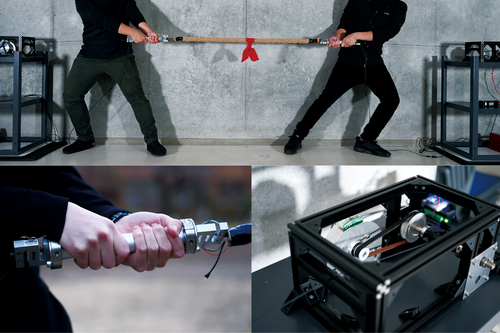
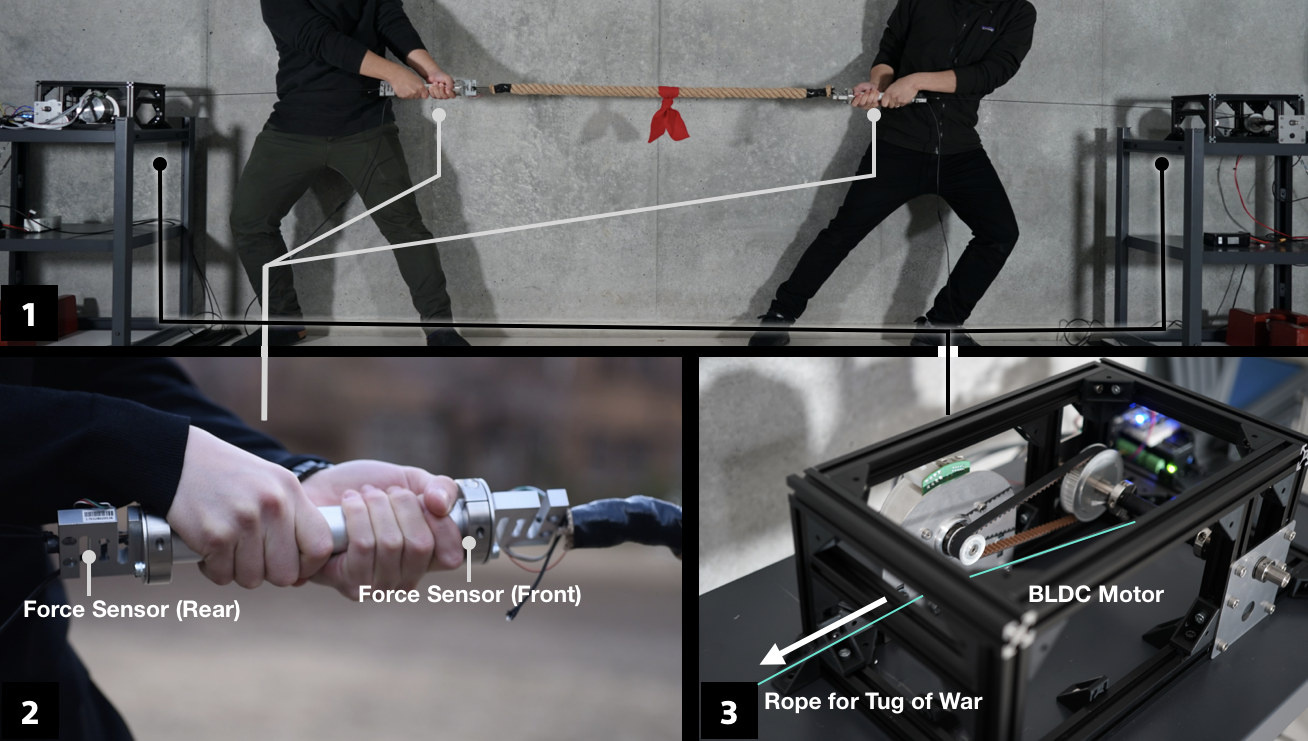
Each player pulls the rope by a handle fitted with two force sensors, one at the front and one at the rear, which together show how the player is applying force. Behind each player, a brushless DC motor pulls at the end of the rope; it has a large diameter and a low reduction ratio, chosen for high torque and backdrivability. Both motors are hidden from the players. A computer sets the motor torques from the force sensor signals, and a remote user interface lets a mediator control and intervene in the game.
Intervening without the players noticing
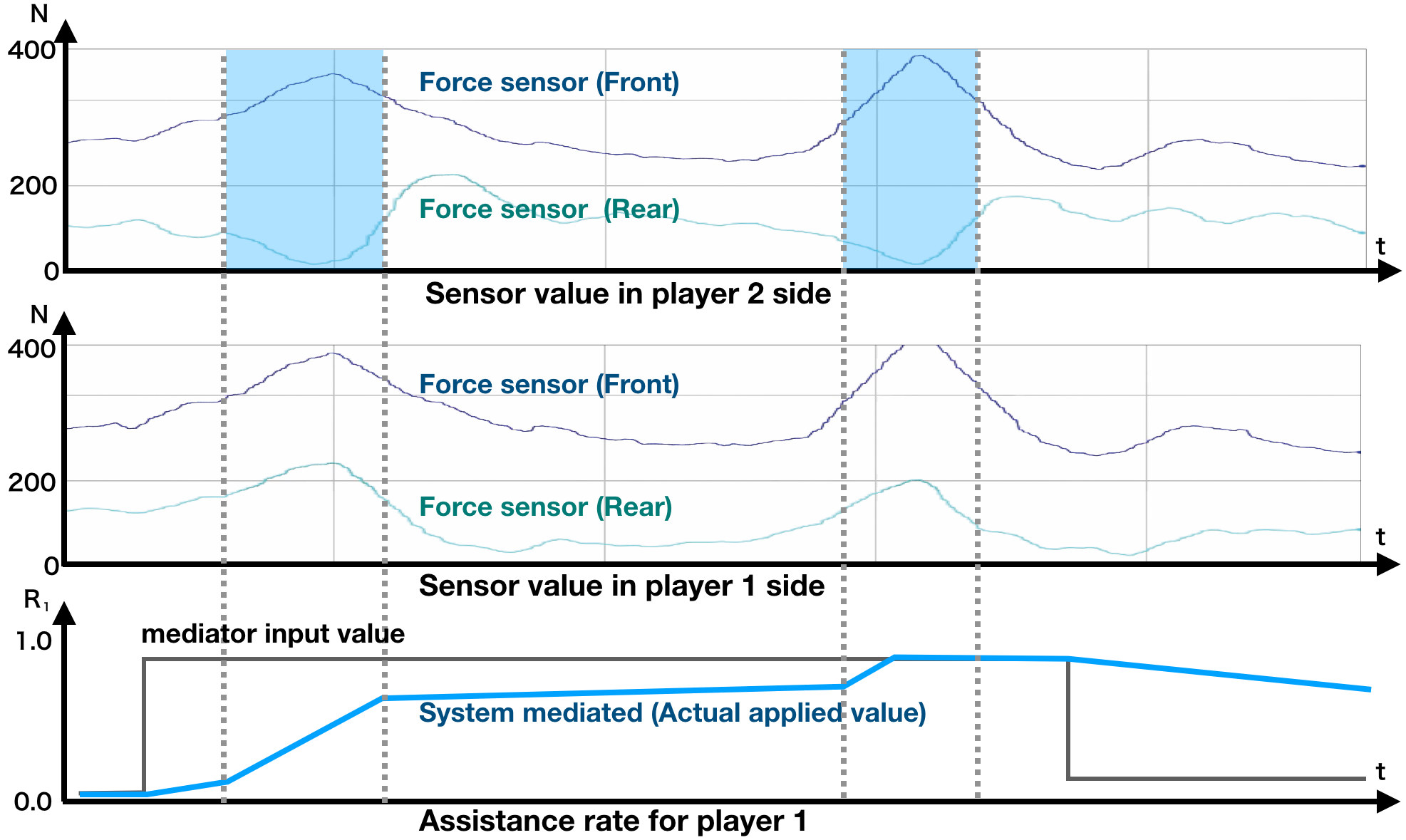
The Tight Game changes how much it helps each player only while the players are actively pulling, so the change in force comes together with their own effort: the players believe they are in a tight game, while the system or a mediator controls how it goes.
Each motor’s force depends non-linearly on how hard both players are pulling at the front sensors. Following the Weber–Fechner law between applied and perceived force in muscle activity, the assistance stays within the range of forces people produce, which makes it less noticeable; a small constant force keeps the rope from going slack. The mediator shifts the balance between the two players by changing their assistance rates, which always add up to one.
Timing the changes turned out to matter. In a preliminary experiment, sudden changes in the assistance rate let players notice the external force, because the weight of the rope changed out of step with their own actions. The system therefore changes the assistance rates only while the players are actively pulling, which it detects as the difference between the two sensors on a handle. The rates move gradually toward the mediator’s input, and quickly only when the player to be assisted gives a big pull.
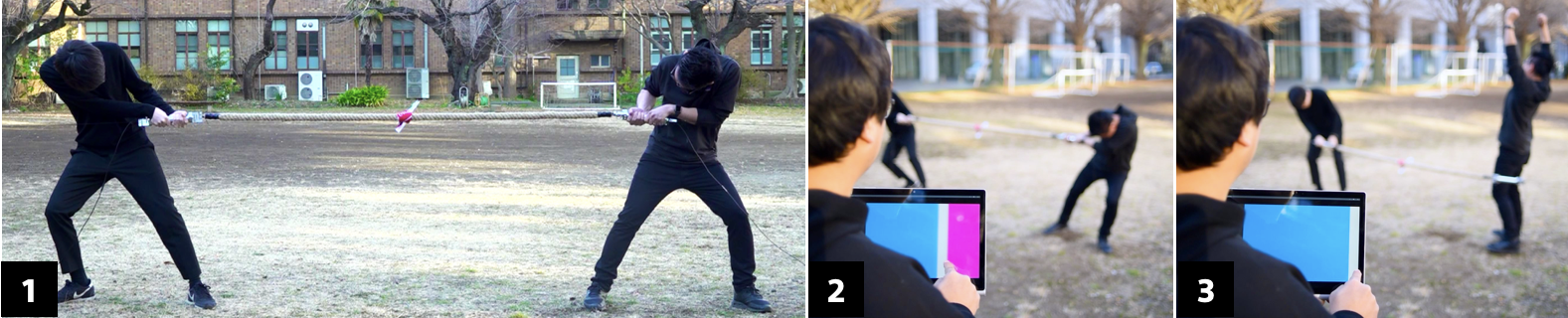
With this design, the paper demonstrates a way to balance physical differences between players without compromising their sense of agency and their engagement, using tug of war as one example of physical interaction between people.
Reference
Azumi Maekawa, Shunichi Kasahara, Hiroto Saito, Daisuke Uriu, Gowrishankar Ganesh, and Masahiko Inami. 2020. The Tight Game: Implicit Force Intervention in Inter-personal Physical Interactions on Playing Tug of War. In ACM SIGGRAPH 2020 Emerging Technologies (SIGGRAPH ’20). Association for Computing Machinery, New York, NY, USA, Article 10, 1–2. https://doi.org/10.1145/3388534.3407301
BibTeX
@inproceedings{10.1145/3388534.3407301,
  author    = {Maekawa, Azumi and Kasahara, Shunichi and Saito, Hiroto and Uriu, Daisuke and Ganesh, Gowrishankar and Inami, Masahiko},
  title     = {The Tight Game: Implicit Force Intervention in Inter-personal Physical Interactions on Playing Tug of War},
  booktitle = {ACM SIGGRAPH 2020 Emerging Technologies},
  series    = {SIGGRAPH '20},
  year      = {2020},
  articleno = {10},
  pages     = {1--2},
  publisher = {Association for Computing Machinery},
  address   = {New York, NY, USA},
  doi       = {10.1145/3388534.3407301}
}
Figures from the paper (Maekawa et al., SIGGRAPH ’20 Emerging Technologies). © 2020 Copyright held by the owner/author(s).
- News: The Tight Game was accepted to SIGGRAPH 2020 Emerging Technologies, Online presentation at SIGGRAPH 2020 Emerging Technologies
- Press: SIGGRAPH 2020 to spotlight 20 transformative, emerging technologies, 綱引きの“八百長装置” 外部から引力をこっそり制御、接戦を演出 東大など「The Tight Game」開発 (ITmedia NEWS)
- Related project: Behind The Game