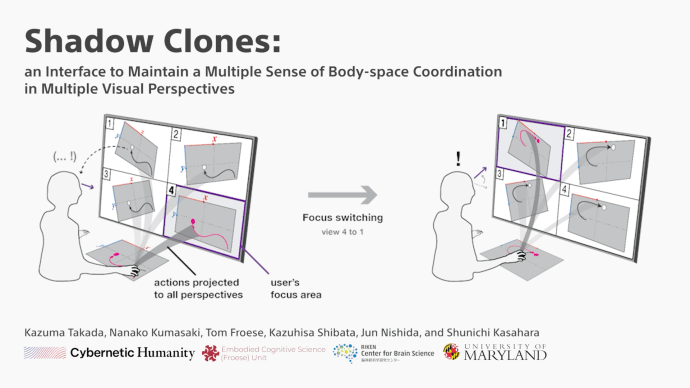
ShadowClones: an Interface to Maintain a Multiple Sense of Body-space Coordination in Multiple Visual Perspectives We propose ShadowClones, an interface that supports interactions in which a single user can interact with multiple bodies in multiple spaces. Recent teleoperation technologies have allowed a user controlling multiple objects simultaneously, but at the same time, it also exhibited…
How can the computer facilitate interpersonal joint action, which is the collaborative action conducted by multiple persons? To explore this research question, we develop EMAS (ElectroMagnetic Actuation System): a motion transfer system using electromagnets, allowing the users to share their finger motion. EMAS consisting of wearable magnets and electromagnets can drive finger motions such as…
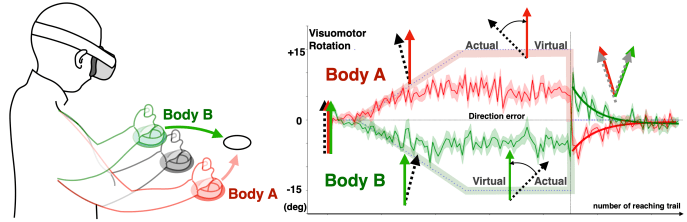
Parallel Adaptation: Switching between Two Virtual Bodies with Different Perspectives Enables Dual Motor AdaptationAdrien Verhulst, Yasuko Namikawa, Shunichi Kasahara (Sony CSL), The 21st IEEE ISMAR 2022 Full Paper. Abstract Virtual Reality (VR) lets us experiment embodiment. Here we investigate dual embodiment under the prism of dual motor adaptation. We asked participants (N=21) to perform reaching…
Human Latent Metrics: Perceptual and Cognitive Response Correlates to Distance in GAN Latent Space for Facial Images ABSTRACT Generative adversarial networks (GANs) generate high-dimensional vector spaces (latent spaces) that can interchangeably represent vectors as images. Advancements have extended their ability to computationally generate images indistinguishable from real images such as faces, and more importantly, to…
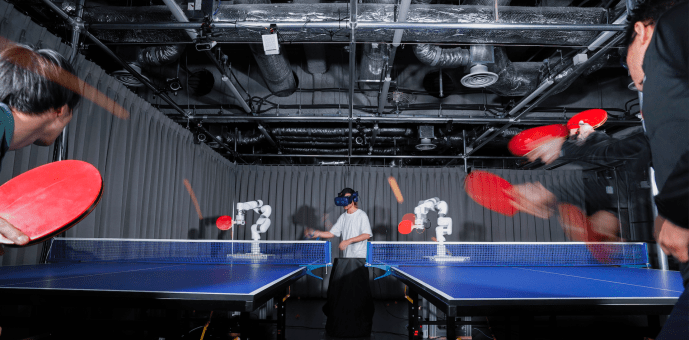
Parallel Ping-Pong: Demonstrating Parallel Interaction through Multiple Bodies by a Single User We explore a “Parallel Interaction”, where a user controls several bodies concurrently. Here we implemented “Parallel Ping-Pong” as a demonstration of such interaction. The user plays ping-pong by controlling 2 robot arms with a Virtual Reality controller, and while looking from the viewpoint…
Whose touch is this? Understanding the Agency Trade-off Between User-driven touch vs. Computer-driven Touch ACM Transactions on Computer-Human Interaction (full paper) Daisuke Tajima, Jun Nishida, Pedro Lopes, and Shunichi Kasahara. Force-feedback interfaces actuate the user’s to touch involuntarily (using exoskeletons or electrical muscle stimulation); we refer to this as computer-driven touch. Unfortunately, forcing users to touch…
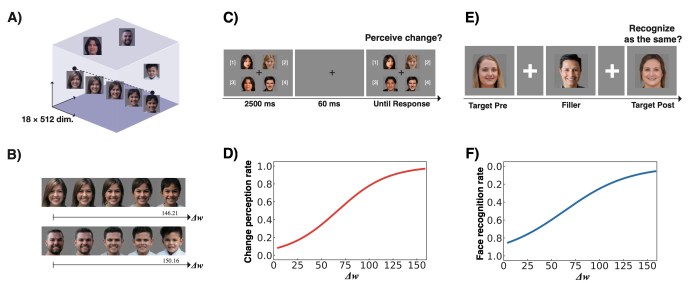
Stealth Updates of Visual Information by Leveraging Change Blindness and Computational Visual Morphing Shunichi Kasahara (Sony CSL), Kazuma Takada (Sony CSL) This paper will be presented in ACM SAP’21 / ACM Transactions on Applied Perception (TAP) Abstract We present an approach for covert visual updates by leveraging change blindness with computationally generated morphed images. To…
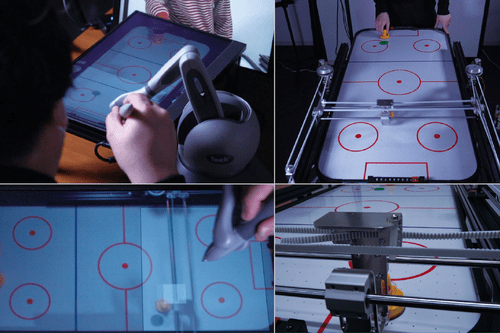
Behind the Game: Implicit Spatio-temporal Intervention in Inter-personal Remote Physical Interactions on Playing Air Hockey The collaboration project with Azumi Maekawa, Hiroto Saito, Narin Okazaki and Masahiko Inami (RCAST, The University of Tokyo) ABSTRACT When playing inter-personal sports games remotely, the time lag between user actions and feedback decreases the user’s performance and sense of agency. While computational assistance can improve…
Credits– Shunichi Kasahara (Sony CSL)– Satoru Higa (BACKSPACE Productions Inc. ) Fragment Shadow is an interactive art of real physical shadows cast by audiences in precisely calibrated projection space. Fragment Shadow system creates a unique projection space with a large screen surface from multiple projectors by comprehensive spatial geometry and color calibration process. When human…




 Cybernetic Humanity