Low-Latency Motion Transfer with Electromagnetic Actuation for Joint Action
Daisuke Tajima, Taku Tanichi, Mohammad H. Shehata, and Shunichi Kasahara
ACM SIGGRAPH Asia 2022 Emerging Technologies
Paper (ACM Digital Library) · PDF
Abstract
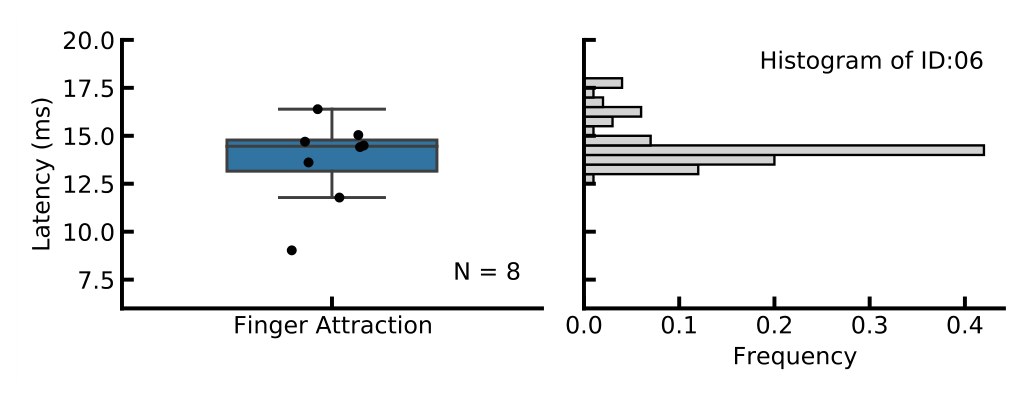
Joint action, performing a task together by multiple people, can be beneficial in transferring the embodied skill, establishing physical relationships, engaging multiple people, and completing the task more effectively. To facilitate real-time joint bodily action, we introduce a low-latency motion transfer system (total latency: 22.9 ± 2.0 ms, finger attraction latency: 13.7 ± 2.1 ms) using electromagnetic actuation, which allows them to share their instantaneous actions, such as pressing the button with their fingers. Our system can change the type of motion transfer at both the direction of the transfer between users (mono- or bi-direction) and the input logic (“AND” or “OR”) based on the users’ input. We will discuss its potential as a computer-assisted joint action and the possibility that the computer system orchestrates the joint action between the users or the user and the computer.
Acting together through each other’s fingers
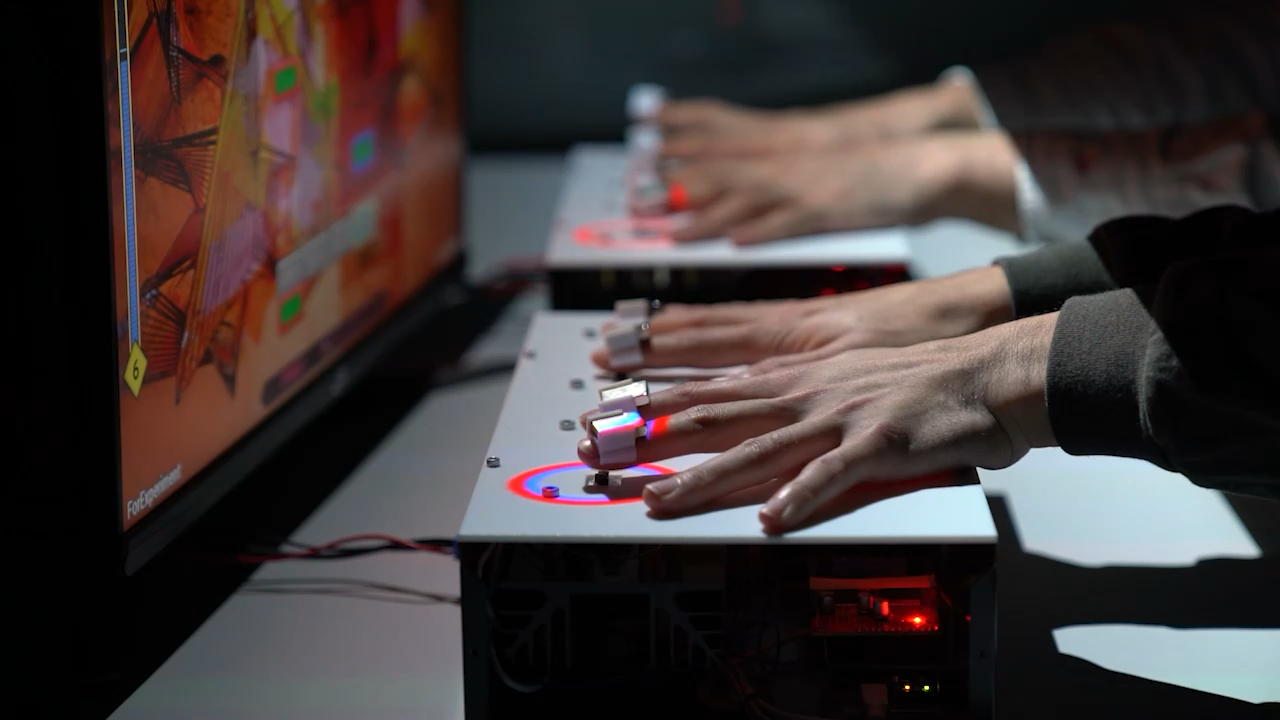
Many tasks are done by several people at once: two people lifting a piece of furniture, a teacher moving a student’s hand to paint, players in a video game. In such joint action, people keep in step through what they see, hear and feel of each other. How can a computer support joint action between people? We approached this question by letting people share the action itself: with EMAS (ElectroMagnetic Actuation System), one person’s finger motion is passed on to another person’s finger.
Moving a finger with a magnet
Each user wears small attachments with neodymium magnets on the index and middle fingers of both hands, four fingers in all. An electromagnet under each button attracts or repels the finger, so the system can make the user press the button. The force is about 2.0 N, enough to move the finger, while the user can still resist it. Unlike electrical muscle stimulation, the actuation causes no electric sensation, and unlike an exoskeleton, it does not restrain the hand.

The actuation is fast. From the activation of the electromagnet to the finger-driven button press takes 13.7 ± 2.1 ms on average, and the whole transfer, from one user’s button press to the other user’s press, takes 22.9 ± 2.0 ms. For comparison, electrical muscle stimulation needs about 40 ms and an exoskeleton about 200 ms. The transfer also works over the Internet, not only between people sitting side by side.
Orchestrating joint action
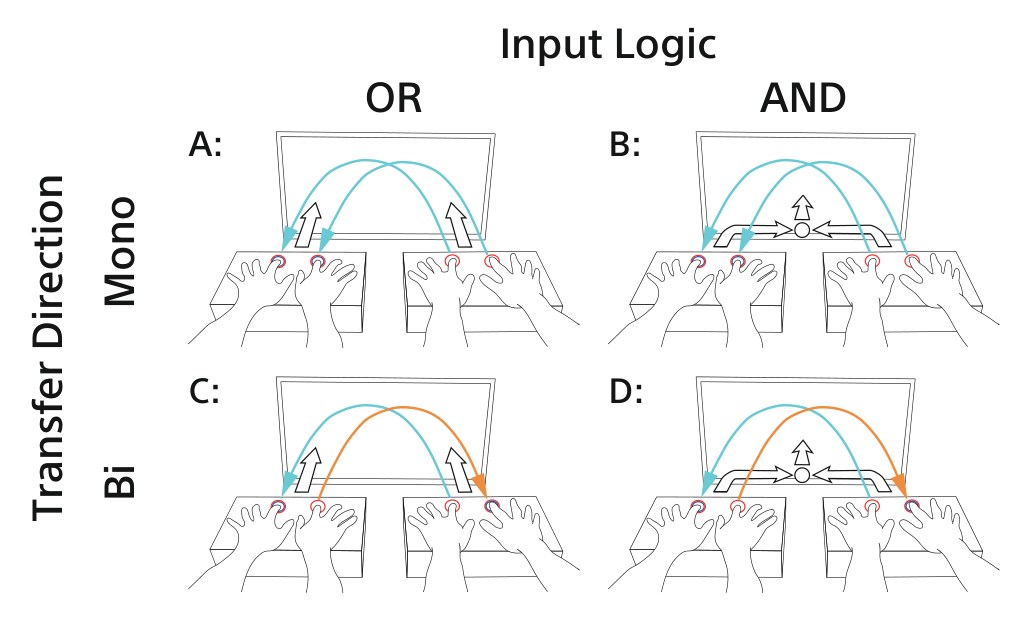
Because one person’s press can move another person’s finger within about 23 ms, the computer can decide how two people act together: whose motion goes to whom, and whether one person’s press is enough or both have to agree. EMAS combines two settings, the direction of the transfer (mono or bi) and the input logic (OR or AND), into four patterns of joint action:
- Mono-direction, OR input: one user’s motion is transferred to the other, and either user’s press counts, so one user assists the other’s action through the system.
- Mono-direction, AND input: the motion is transferred one way, and a press counts only when both users press, so one user steers the other, “just like a marionette”.
- Bi-direction, OR input: the users exchange their motions and each press counts, so they collaborate through motor and haptic cues in their own fingers.
- Bi-direction, AND input: the users exchange their motions, but a press counts only when both press at once. A user who disagrees can resist the attraction and block the input, so the two have to reach a consensus.
Low-latency motion transfer thus turns joint action into something a computer can shape: the system can orchestrate the joint action between users, or between a user and the computer. Together with our study of the feeling of control under computer-driven touch (Whose touch is this?), it lets us explore scenarios of joint action in real time, even over distance.
Credits
Daisuke Tajima (Sony Computer Science Laboratories, Inc.)
Taku Tanichi (Sony Computer Science Laboratories, Inc., Keio Media Design)
Mohammad H. Shehata (California Institute of Technology, Toyohashi University of Technology)
Shunichi Kasahara (Sony Computer Science Laboratories, Inc.)
Reference
Daisuke Tajima, Taku Tanichi, Mohammad H. Shehata, and Shunichi Kasahara. 2022. Low-Latency Motion Transfer with Electromagnetic Actuation for Joint Action. In SIGGRAPH Asia 2022 Emerging Technologies (SA ’22). Association for Computing Machinery, New York, NY, USA, Article 6, 1–2. https://doi.org/10.1145/3550471.3558399
BibTeX
@inproceedings{10.1145/3550471.3558399,
  author    = {Tajima, Daisuke and Tanichi, Taku and Shehata, Mohammad H. and Kasahara, Shunichi},
  title     = {Low-Latency Motion Transfer with Electromagnetic Actuation for Joint Action},
  booktitle = {SIGGRAPH Asia 2022 Emerging Technologies},
  series    = {SA '22},
  year      = {2022},
  articleno = {6},
  pages     = {1--2},
  publisher = {Association for Computing Machinery},
  address   = {New York, NY, USA},
  doi       = {10.1145/3550471.3558399}
}
Figures from the paper (Tajima et al., SIGGRAPH Asia ’22 Emerging Technologies). © 2022 Copyright held by the owner/author(s).
- Related projects: Faster Than Muscle, Whose touch is this?, Preemptive Action