Faster Than Muscle: Executing Action based on Voluntary Nervous Signals
Gabriela Vega, Johanna K. Didion, Reshma Ann Daniel, Nihar Sabnis, Daisuke Tajima, Shunichi Kasahara, and Paul Strohmeier
ACM UIST 2026
The collaboration project with the leading author, Gabriela Vega, and Paul Strohmeier (Max Planck Institute for Informatics).
Abstract
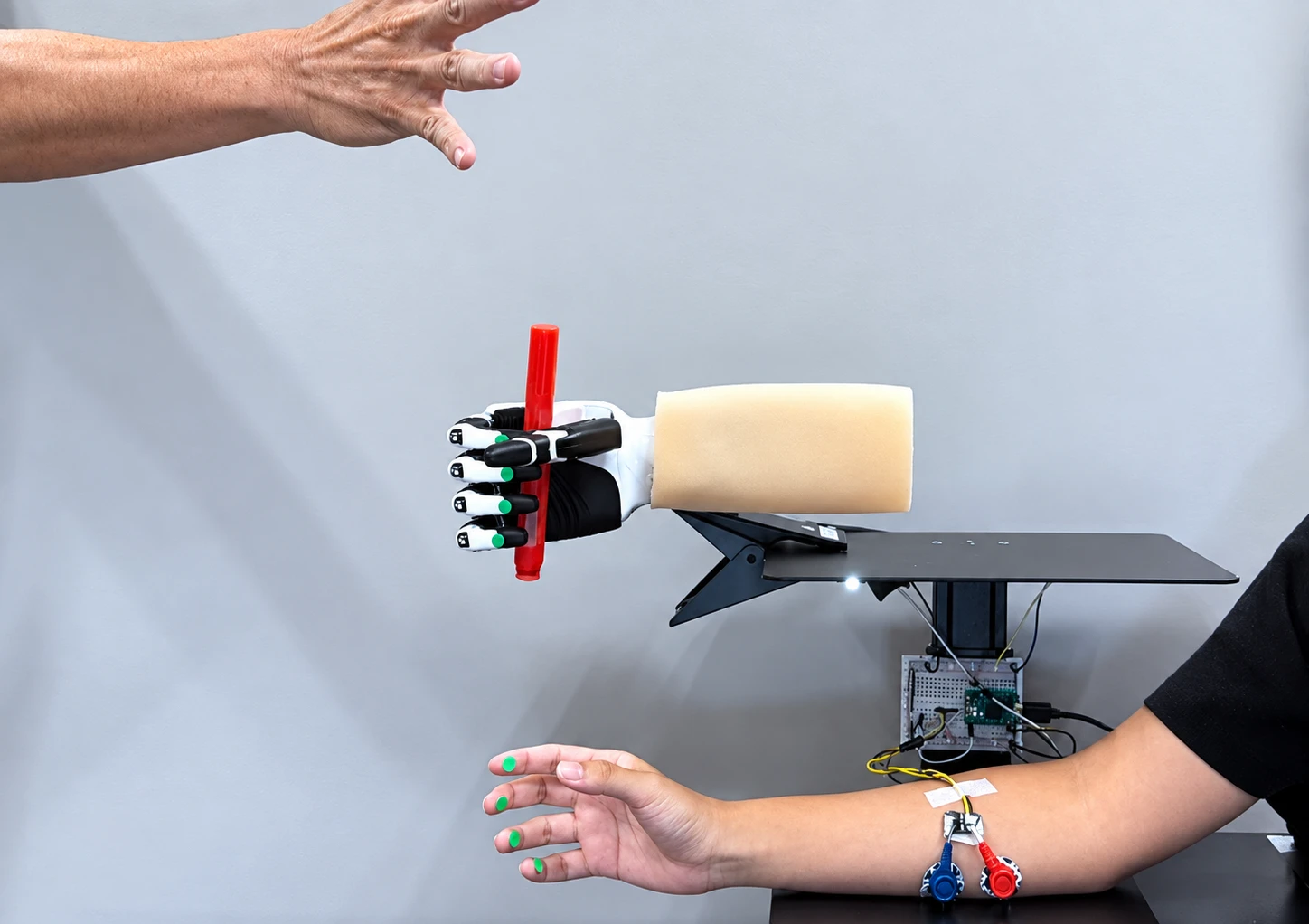
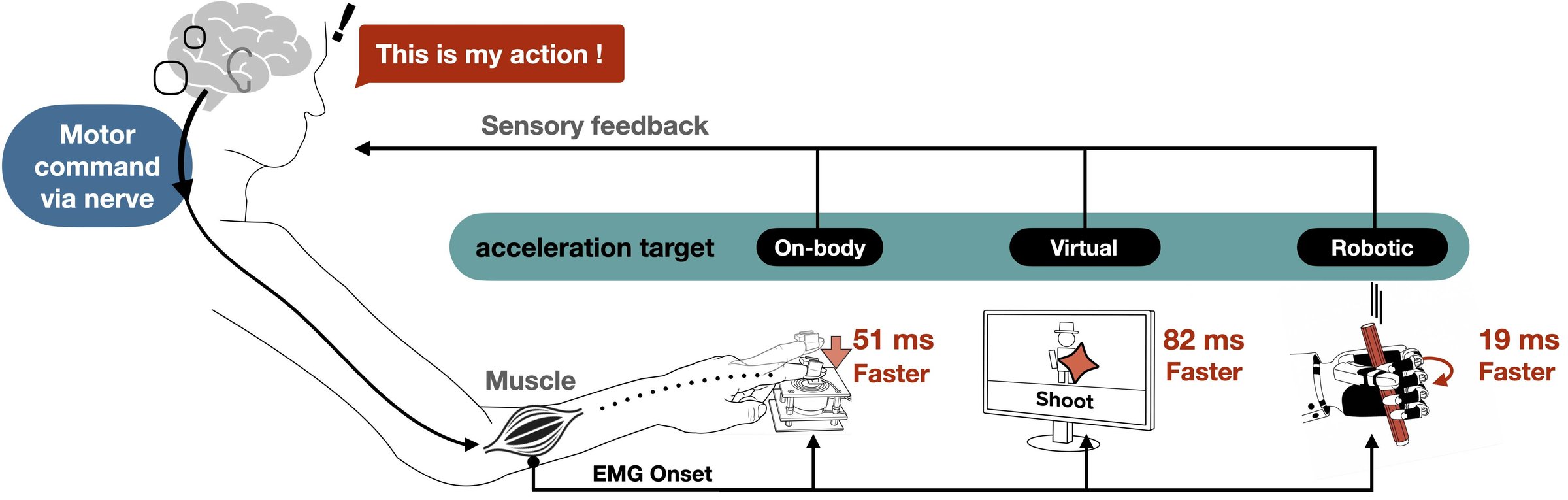
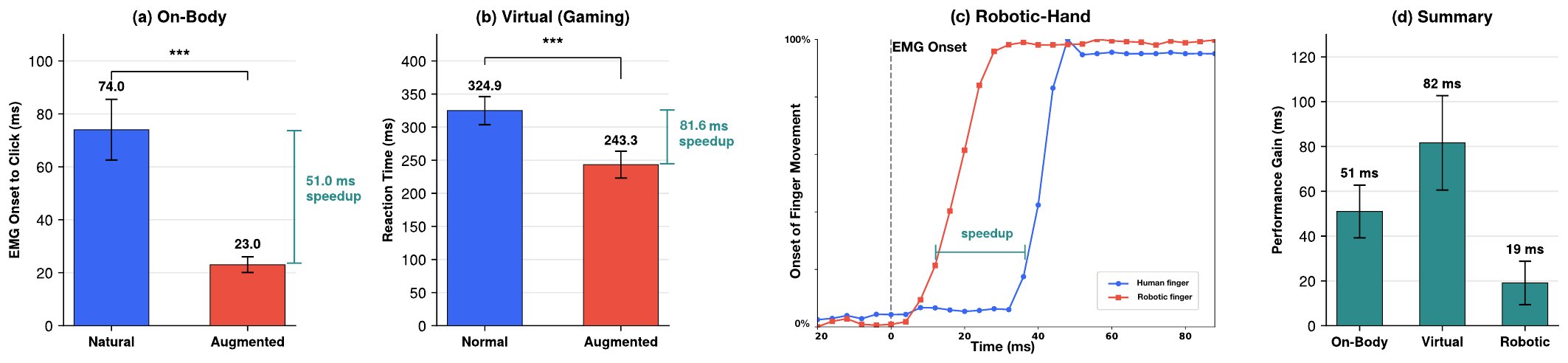
Human augmentation enables actions that surpass biological limits, but earlier intervention in the action loop can undermine user agency. We introduce human-in-the-loop action acceleration, a design approach that anchors action acceleration to voluntary initiation. Using forearm EMG onset, the system triggers actuation within the electromechanical delay (EMD), enabling earlier execution without relying on predictive inference. We implement this approach in Faster Than Muscle, a system with three instantiations: (1) on-body finger actuation achieving a 51 ms speedup, (2) EMG-triggered software input for a shooting task (82 ms speedup), and (3) bionic-hand actuation for catching a falling object (19 ms speedup). Across two studies (temporal binding experiment and qualitative interview study) and accompanying system evaluations, we show that EMG-triggered acceleration improves performance in time-critical tasks, while users retain a sense of agency. These results show that actions can be accelerated beyond biological limits while remaining grounded in voluntary initiation, and outline a design space spanning execution targets and feedback timing.
Three acceleration targets
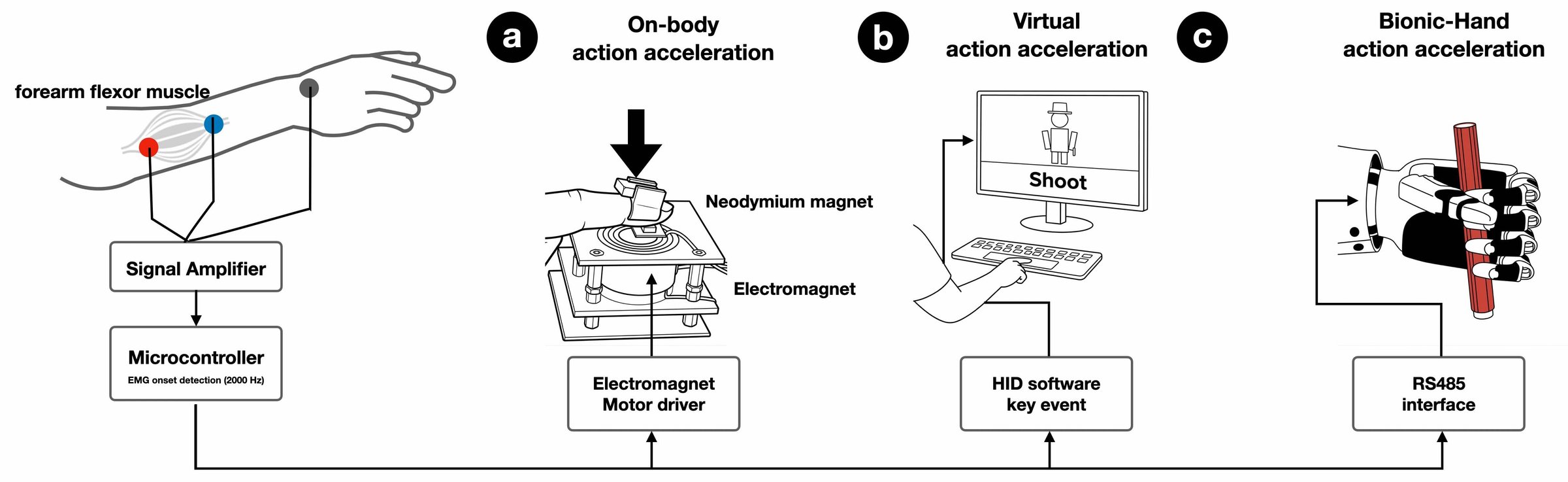
A forearm EMG sensor detects the onset of voluntary muscle activation, and the same pipeline sends the action to one of three targets:
- On-body (about 51 ms faster): an electromagnet moves the user’s own finger to press a key, so that the feel of the press, its sound, and what the user sees all arrive earlier. It builds on EMAS.
- Virtual (about 82 ms faster): a key event reaches the game Shoot or Die before the physical press registers, while the user still presses the key as usual.
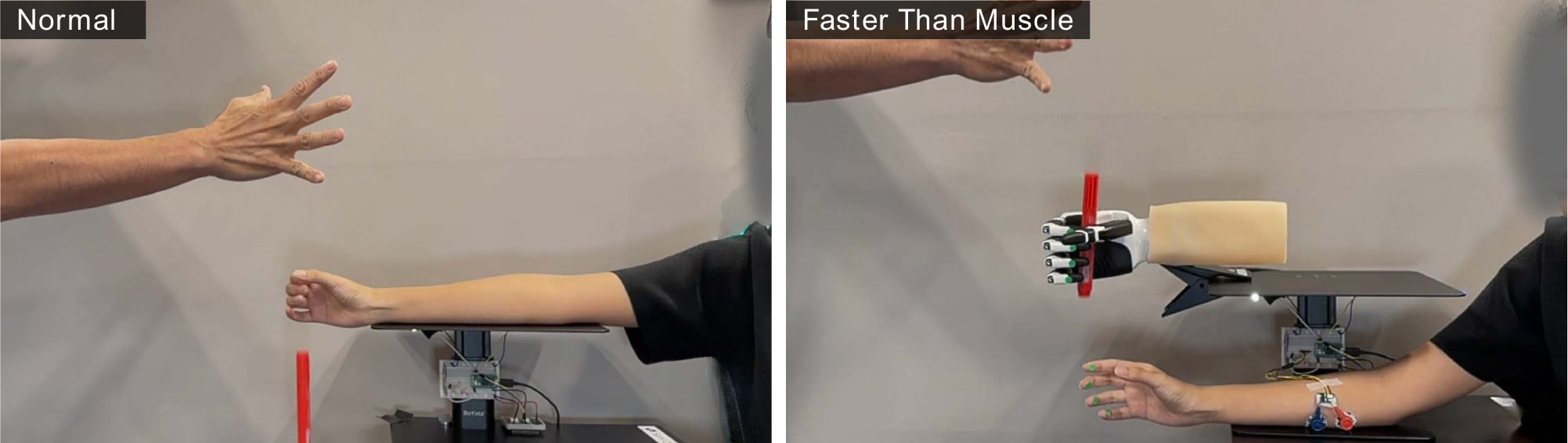
- Robotic (about 19 ms faster): a bionic hand starts closing before the user’s own fingers visibly move, in time to catch a falling pen.
Sense of agency
In a temporal binding study with the Libet clock (27 participants), the accelerated presses the participants initiated themselves were rated far higher in agency than the same movement triggered at random, though lower than unassisted presses. In a gaming study (8 participants), EMG-triggered input raised the hit rate from about 54% to 83%, and participants reported a stronger sense of control, even though what they saw and heard came before the feel of their own key press.
Reference
Gabriela Vega, Johanna K. Didion, Reshma Ann Daniel, Nihar Sabnis, Daisuke Tajima, Shunichi Kasahara, and Paul Strohmeier. 2026. Faster Than Muscle: Executing Action based on Voluntary Nervous Signals. In Proceedings of the 39th Annual ACM Symposium on User Interface Software and Technology (UIST ’26). Association for Computing Machinery, New York, NY, USA, 13 pages. https://doi.org/10.1145/3830398.3830666
BibTeX
@inproceedings{10.1145/3830398.3830666,
  author    = {Vega, Gabriela and Didion, Johanna K. and Daniel, Reshma Ann and Sabnis, Nihar and Tajima, Daisuke and Kasahara, Shunichi and Strohmeier, Paul},
  title     = {Faster Than Muscle: Executing Action based on Voluntary Nervous Signals},
  booktitle = {Proceedings of the 39th Annual ACM Symposium on User Interface Software and Technology},
  series    = {UIST '26},
  year      = {2026},
  numpages  = {13},
  publisher = {Association for Computing Machinery},
  address   = {New York, NY, USA},
  doi       = {10.1145/3830398.3830666}
}
Figures from the paper (Vega et al., UIST ’26), licensed under CC BY 4.0.
- News: Paper Accepted to UIST 2026
- Related projects: Preemptive Action, Wired Muscle, EMAS, Whose touch is this?