Shunichi Kasahara
Nature Sensors 2026
Artificial intelligence (AI) clones could serve as a new interface for scientific communication between publishers and research communities. At a Nature conference in Seoul, multimodal AI clones — including one of the Chief Editor of Nature Sensors — engaged researchers in real-time dialogue about publishing and careers, in three different languages.
An editor’s clone at a Nature conference
Journal editors are an important point of contact between publishers and researchers, who ask them which journal to target, how review works, and even for career advice. Editors are a finite resource, however. Our Circular Interactive AI Clone (CXC) system generates a multimodal AI clone of a specific person, with their appearance, voice, speaking style, expertise and values. The conversations are analysed and returned to that person, who can then update the clone.
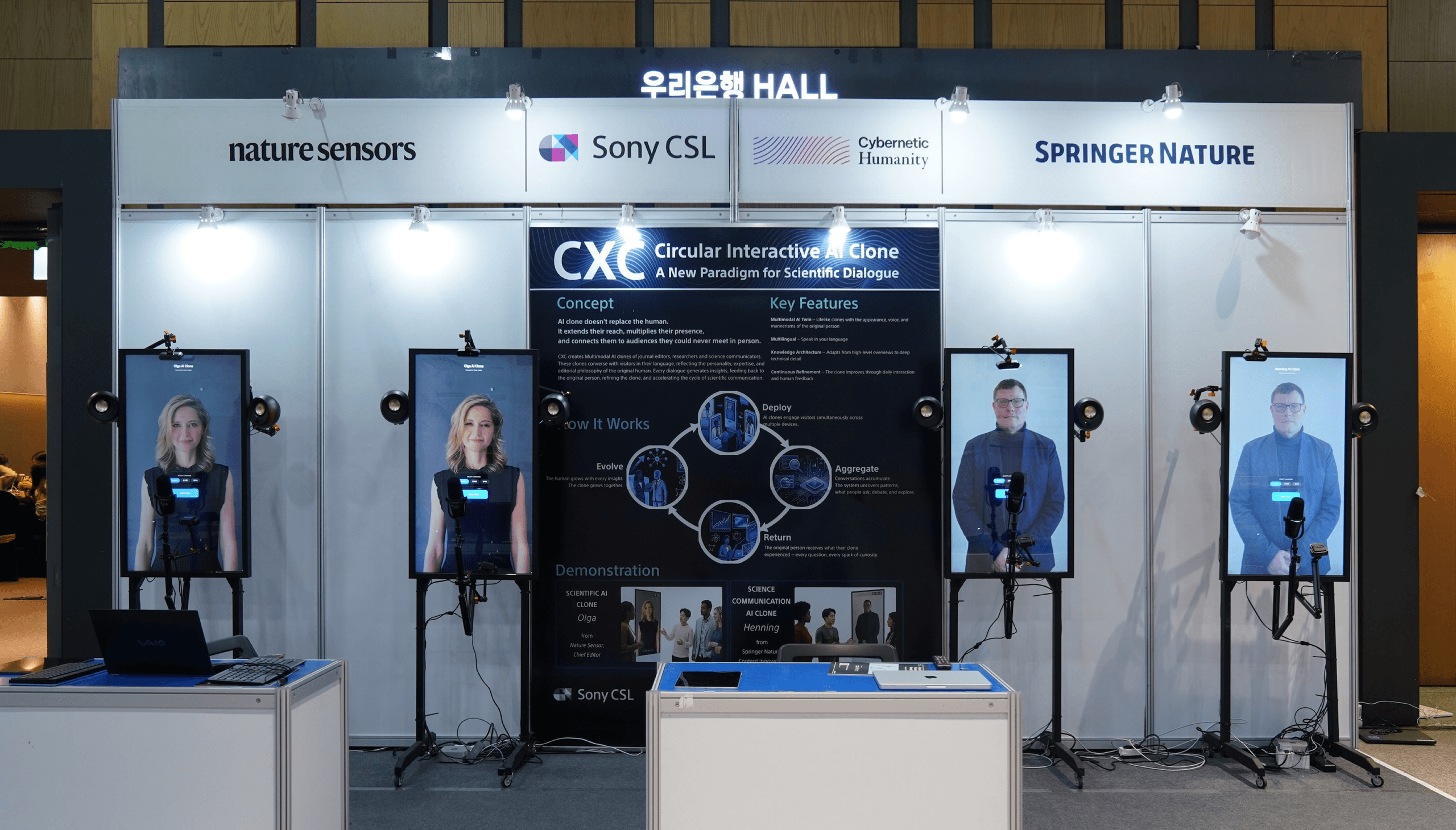
In collaboration with Nature Sensors and Springer Nature, we deployed CXC for the first time at the Nature Forum on the Future of Sensing Technologies, held at Yonsei University in Seoul on 13 April 2026 to celebrate the launch of the journal. Four kiosks ran clones of Olga Bubnova, Chief Editor of Nature Sensors, and Henning Schönenberger, Vice President of Content Innovation at Springer Nature, and talked with attendees in Korean, English and Japanese. Over the one-day conference we recorded 148 sessions with 804 messages; 106 sessions contained active conversation.
View the post on X
Submission consultations were the most frequent topic. One researcher working on tumour-detection sensors spent about 16 minutes with the Olga clone, getting advice on a pre-submission inquiry, and when asked about a water-splitting catalyst study, the clone recommended Nature Catalysis. These were the five-minute chats a researcher might have with an editor over coffee, except that the clone could talk with several attendees at once, with no waiting, in each attendee’s own language.
Beyond information, toward personal dialogue
The clones were valued for more than accurate answers. A graduate student asked the Olga clone for “something that only you can share”, and the clone recounted its own path from researcher to editor; this session received the highest scores on every item of the attendee survey. A long-standing colleague of Olga used the clone to send congratulations on the journal’s launch, and the Henning clone carried on discussions up to ten minutes long, although Henning himself was not at the conference. Some attendees who had consulted the Olga clone then went to talk with Olga in person: the survey item “I feel more prepared to speak with the real person” received the highest score from several attendees, suggesting that the clone can work as an icebreaker.
A circular model for scientific communication
The clone talks with many researchers, and what it learns (which research is headed for submission, what questions the community has, which needs remain unmet) is returned to the original person, so that both the person and the clone evolve. Publishing, by contrast, remains a one-directional broadcast: large language models have made it easier than ever for readers to query papers, but those queries never reach the authors. If an author’s AI clone could converse with readers and return their questions and interests to the author, publishing would shift from broadcast to dialogue. With human-in-the-loop oversight, such clones could turn one-directional publishing into circular scientific communication.
Challenges remain. The clones cannot yet scrutinize specific papers or return precise bibliographic information. How to guarantee the identity between a clone and the original person, how to protect the privacy of dialogue data, and how to govern clones transparently are open questions, and ethical issues such as identity fragmentation, authenticity and dependency bear directly on the trustworthiness of scholarly publishing.
Reference
Shunichi Kasahara. 2026. AI clones in conversation at academic conferences. Nature Sensors 1, 7 (June 2026), 567–568. https://doi.org/10.1038/s44460-026-00089-1
BibTeX
@article{10.1038/s44460-026-00089-1,
  author    = {Kasahara, Shunichi},
  title     = {AI clones in conversation at academic conferences},
  journal   = {Nature Sensors},
  volume    = {1},
  number    = {7},
  year      = {2026},
  pages     = {567--568},
  publisher = {Springer Science and Business Media LLC},
  doi       = {10.1038/s44460-026-00089-1}
}