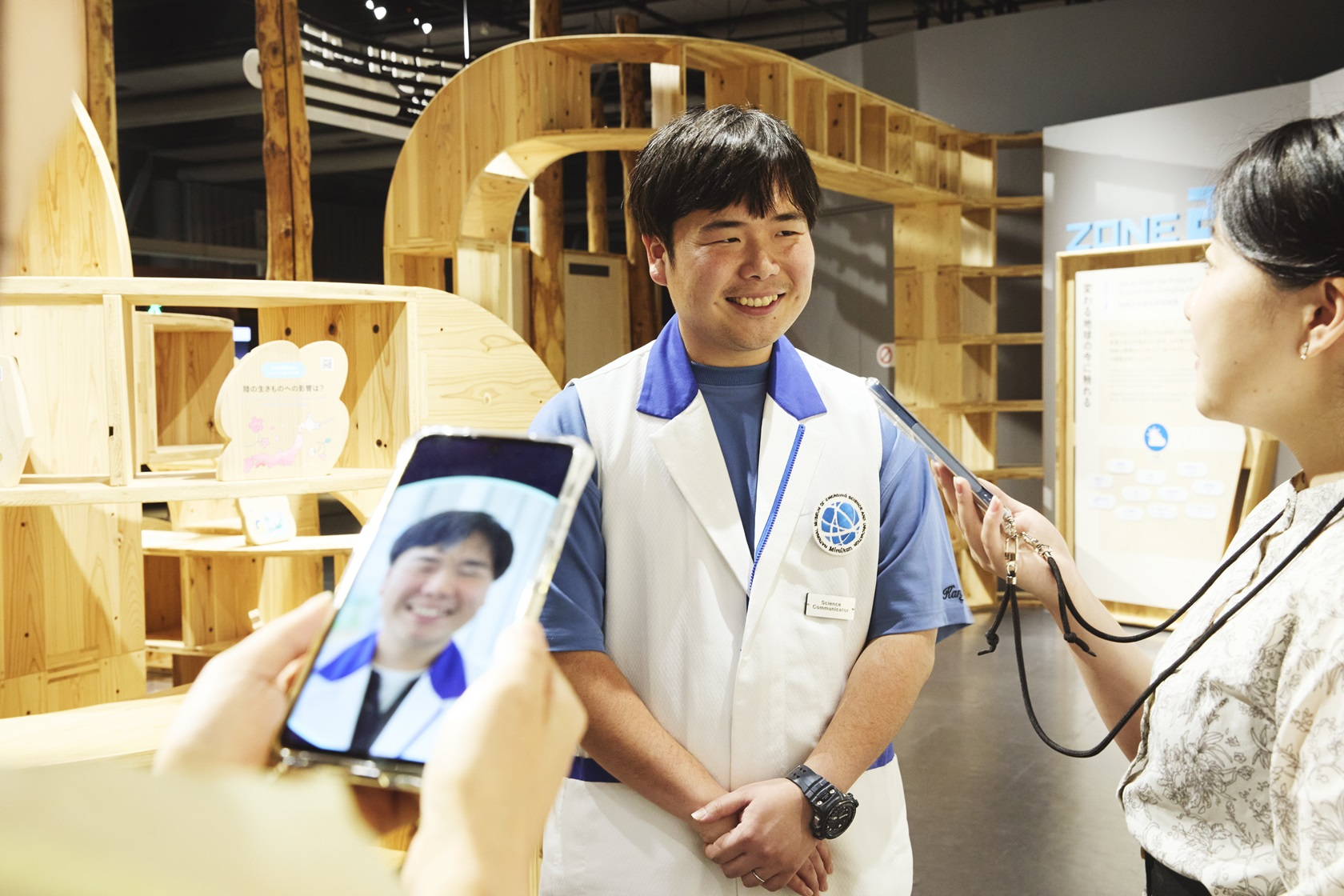
The collaboration project with Shutaro Aoyama, Kiyoshi Suganuma, and the National Museum of Emerging Science and Innovation (MIraikna)
Abstract
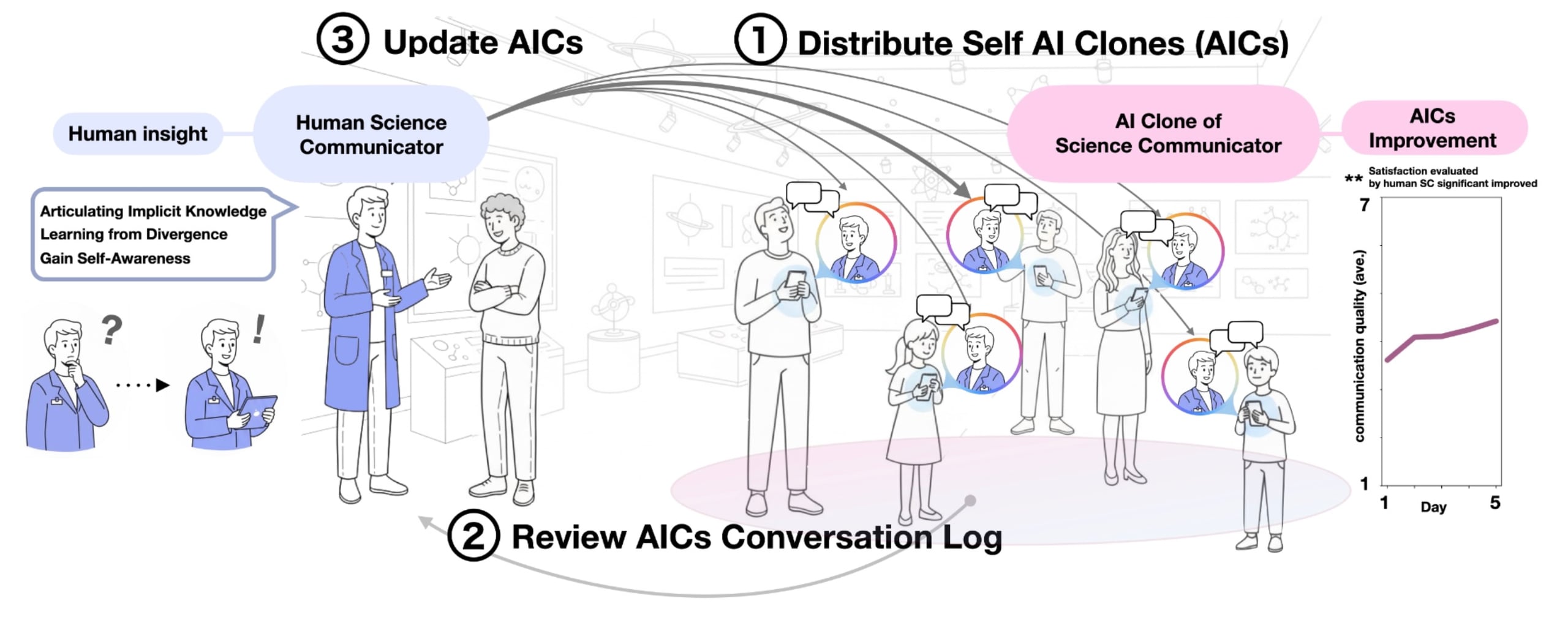
AI Clones (AICs) hold promise for augmenting communication, yet most AICs remain static snapshots that drift out of sync with their evolving source users. Iterative refinement of behavior descriptions offers a potential mechanism for improvement: users review their AIC’s interactions, reflect on its performance, and directly edit the AIC’s behavior descriptions to update its behavior. We investigated this process in a five-day field deployment with six professional science communicators (SCs) at a science museum, making their AICs available in over 450 conversation sessions with visitors on multiple mobile devices. We analyzed conversation logs of AICs, visitor surveys, daily questionnaires from the SCs, and interviews with SCs. Results reveal a marked source–visitor asymmetry. Source users’ evaluations of their AICs showed significant improvement across nine of ten communication dimensions, whereas visitor ratings showed no overall change and reached significance for only one of six AICs after FDR correction. Because the SC and visitor questionnaires were built from parallel items, the two sides are directly comparable. Iterative refinement thus appears to do more for the source user’s relationship with their clone than for the people the clone serves: it helped source users articulate implicit communication strategies, learn from AICs’ divergent behaviors, and gain self-awareness about their professional identities. Furthermore, we found that participants adopted distinct stances toward their AICs, using them for self-reflection and for exploring idealized selves. We synthesize these observations into design implications for supporting diverse relationship patterns in AIC systems.