Emergence and collapse of reciprocity in semiautomatic driving coordination experiments with humans
Hirokazu Shirado, Shunichi Kasahara, and Nicholas A. Christakis
PNAS 2023
The collaboration project with the lead author Hirokazu Shirado (CMU) and Christakis, N (Yale University).
Abstract
Forms of both simple and complex machine intelligence are increasingly acting within human groups in order to affect collective outcomes. Considering the nature of collective action problems, however, such involvement could paradoxically and unintentionally suppress existing beneficial social norms in humans, such as those involving cooperation. Here, we test theoretical predictions about such an effect using a unique cyber-physical lab experiment where online participants (N = 300 in 150 dyads) drive robotic vehicles remotely in a coordination game. We show that autobraking assistance increases human altruism, such as giving way to others, and that communication helps people to make mutual concessions. On the other hand, autosteering assistance completely inhibits the emergence of reciprocity between people in favor of self-interest maximization. The negative social repercussions persist even after the assistance system is deactivated. Furthermore, adding communication capabilities does not relieve this inhibition of reciprocity because people rarely communicate in the presence of autosteering assistance. Our findings suggest that active safety assistance (a form of simple AI support) can alter the dynamics of social coordination between people, including by affecting the trade-off between individual safety and social reciprocity. The difference between autobraking and autosteering assistance appears to relate to whether the assistive technology supports or replaces human agency in social coordination dilemmas. Humans have developed norms of reciprocity to address collective challenges, but such tacit understandings could break down in situations where machine intelligence is involved in human decision-making without having any normative commitments.
Driving assistance and the norms between drivers
Cars increasingly come with active safety assistance that brakes or steers on the driver’s behalf. These systems are designed for the individual driver’s convenience and safety, but they also change the risk of collision and who makes the decision, and so they could interfere with the norms that let people coordinate on their own, such as taking turns giving way at an intersection. The paper uses driving as a model for a broader question about hybrid systems of humans and machines: can machine assistance change how people treat each other?
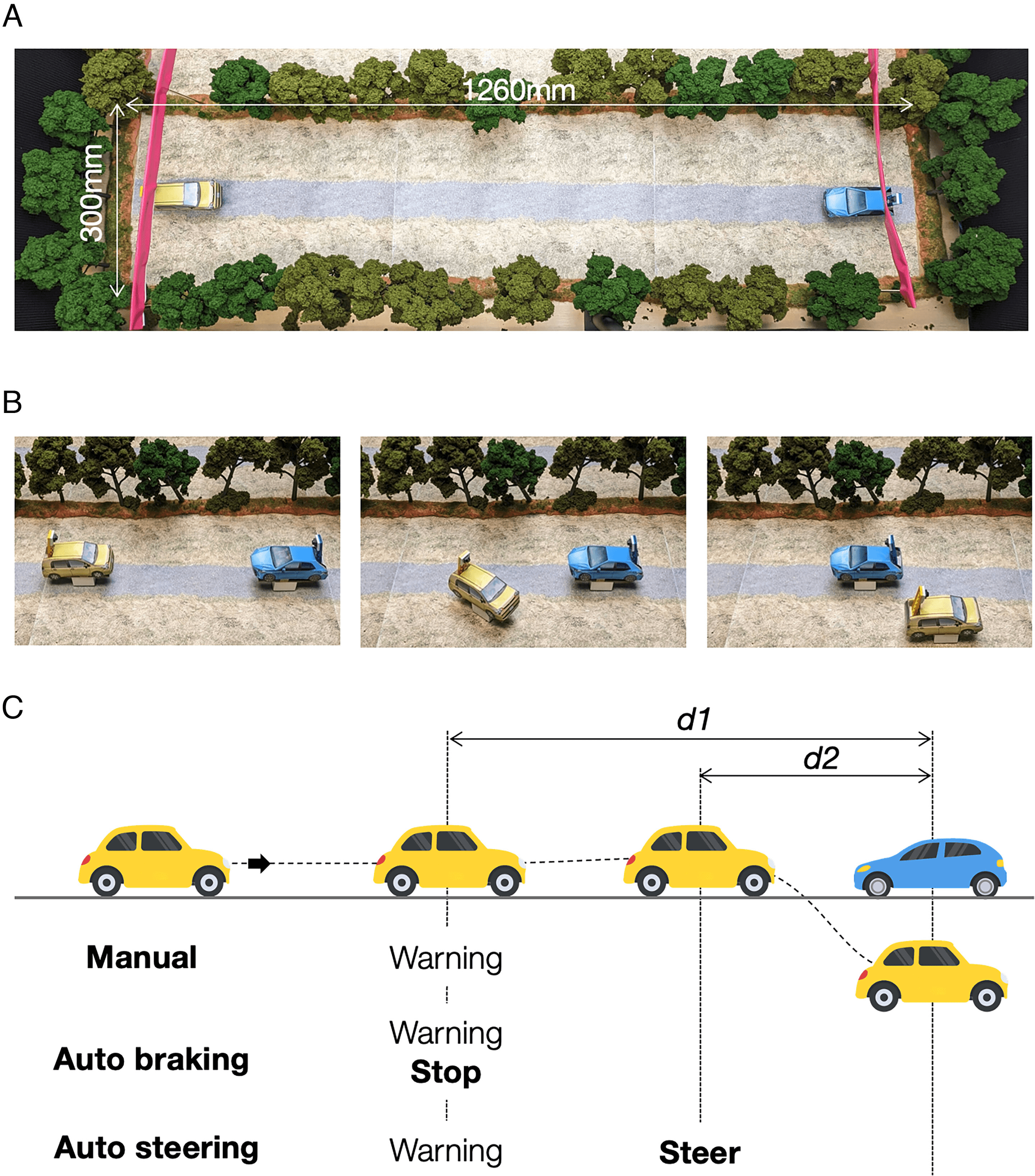
We compared two basic systems. Autobraking stops the car automatically when an obstacle gets close; the driver gains time but still has to decide how to avoid the collision. Autosteering swerves the car automatically, so the driver does not need to decide at all. The first supports human decision-making, and the second replaces it.
A chicken game with robot cars driven over the internet
We used the chicken game, a standard model of coordination. Two drivers head toward each other on a single road, and each wants to reach the goal quickly. Swerving off the road costs time, and if neither swerves, they crash. Over repeated rounds, a pair can take turns giving way, which gives both of them the best payoff, but someone has to concede first without knowing whether the other will return the favor.
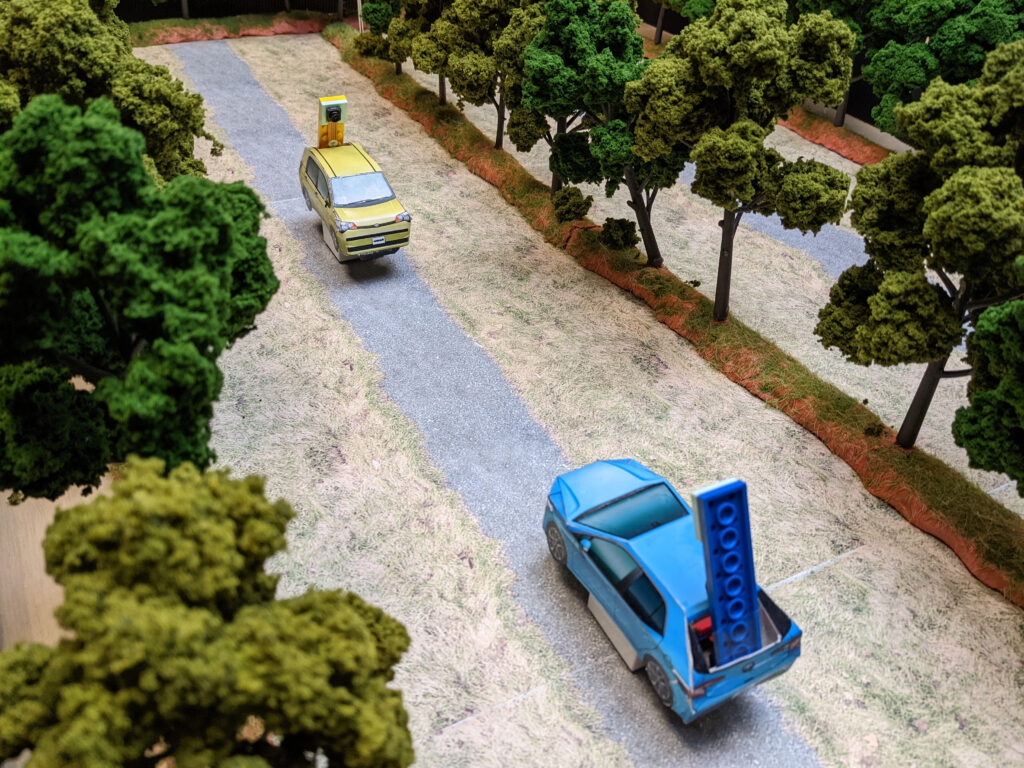
300 participants in 150 pairs, recruited online, drove palm-sized robot cars in a physical diorama from their browsers, using the view from a camera on each car. Each pair played ten rounds for a bonus of up to US$1.50 per round that shrank the longer they took, and driving off the road cut a car’s speed by 75%. Pairs drove manually with only a collision warning, with autobraking, with autosteering, or with both, and half of them could send two fixed messages, “Go ahead.” and “Thank you!”. Both drivers in a pair had the same assistance and knew it. In a supplementary experiment, autosteering was switched on or off after the fifth round.
Reciprocity emerged or collapsed with human agency
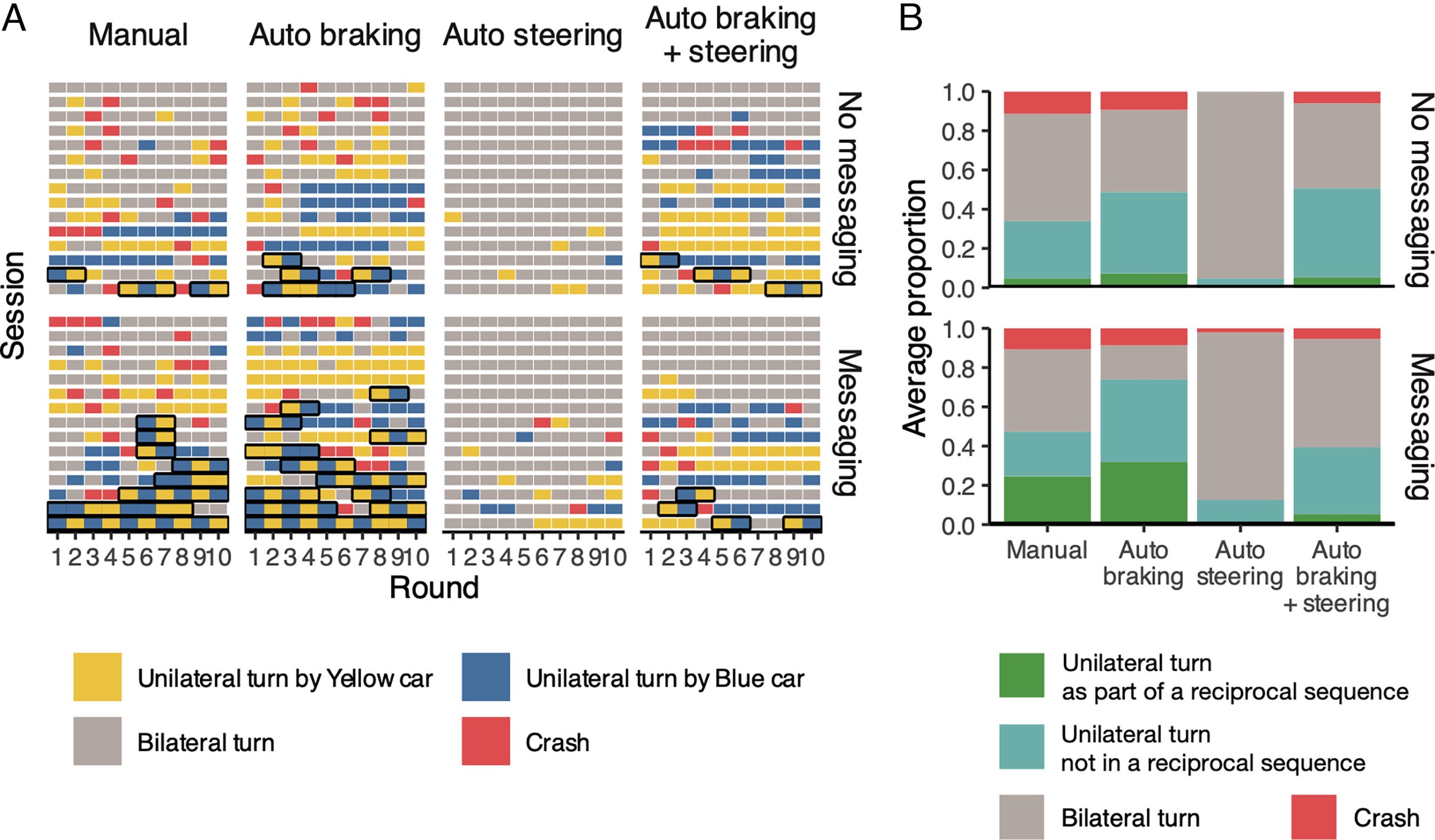
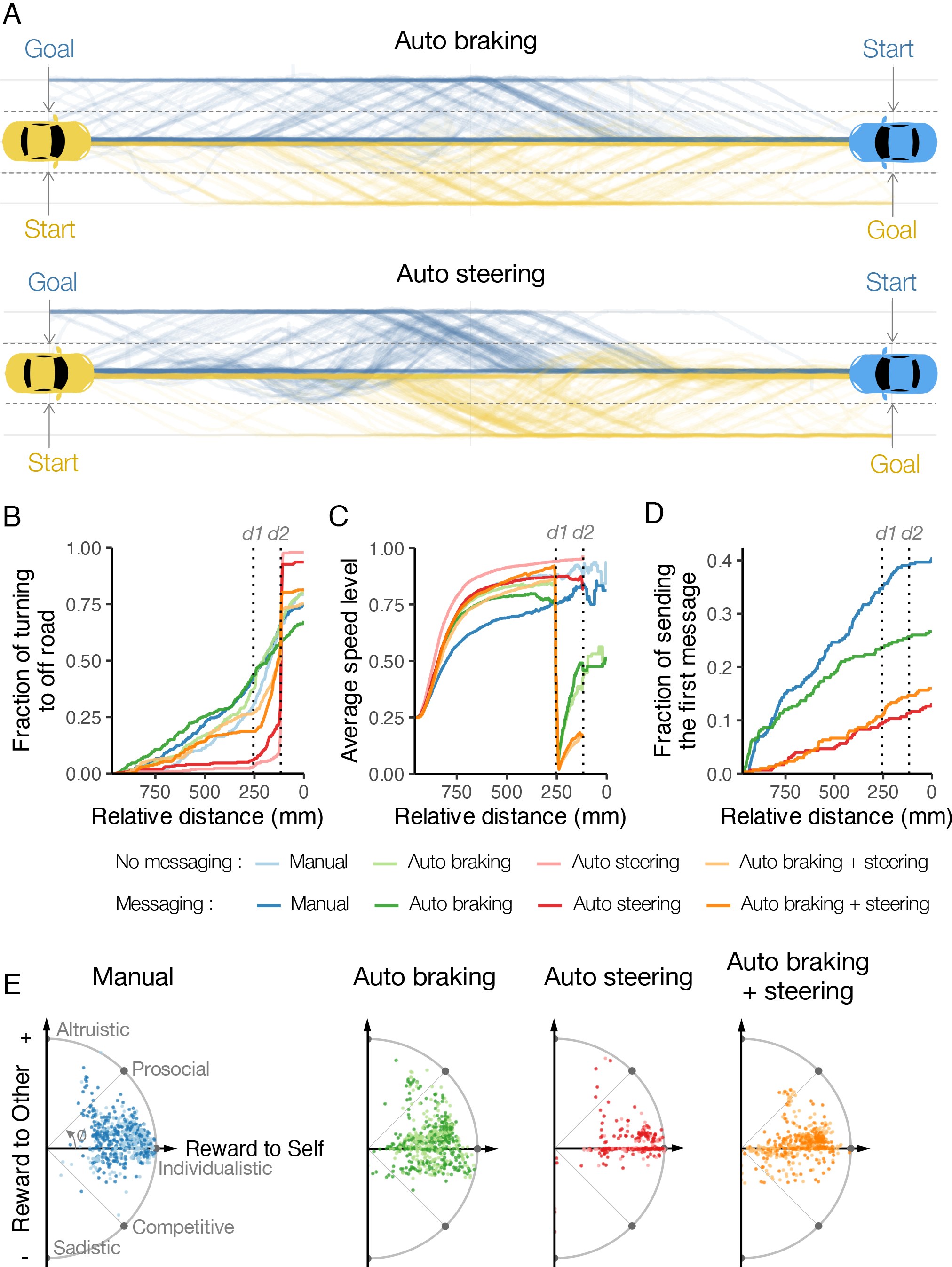
Whether reciprocity emerged or collapsed depended on whether the assistance supported or replaced the drivers’ own decisions: autobraking encouraged people to give way, while autosteering wiped out taking turns entirely, even when the drivers could send messages.
Without messaging, manual drivers let the other pass in 34.6% of rounds but rarely took turns (5.3%), and autobraking raised giving way to 48.6%. Messaging helped pairs turn single concessions into taking turns, which rose to 24.7% of rounds with manual driving and to 32.0% with autobraking. Autosteering cut giving way to 4.7% while also reducing collisions, and no pair took turns in any autosteering session, with or without messages.
Why autosteering made drivers egocentric
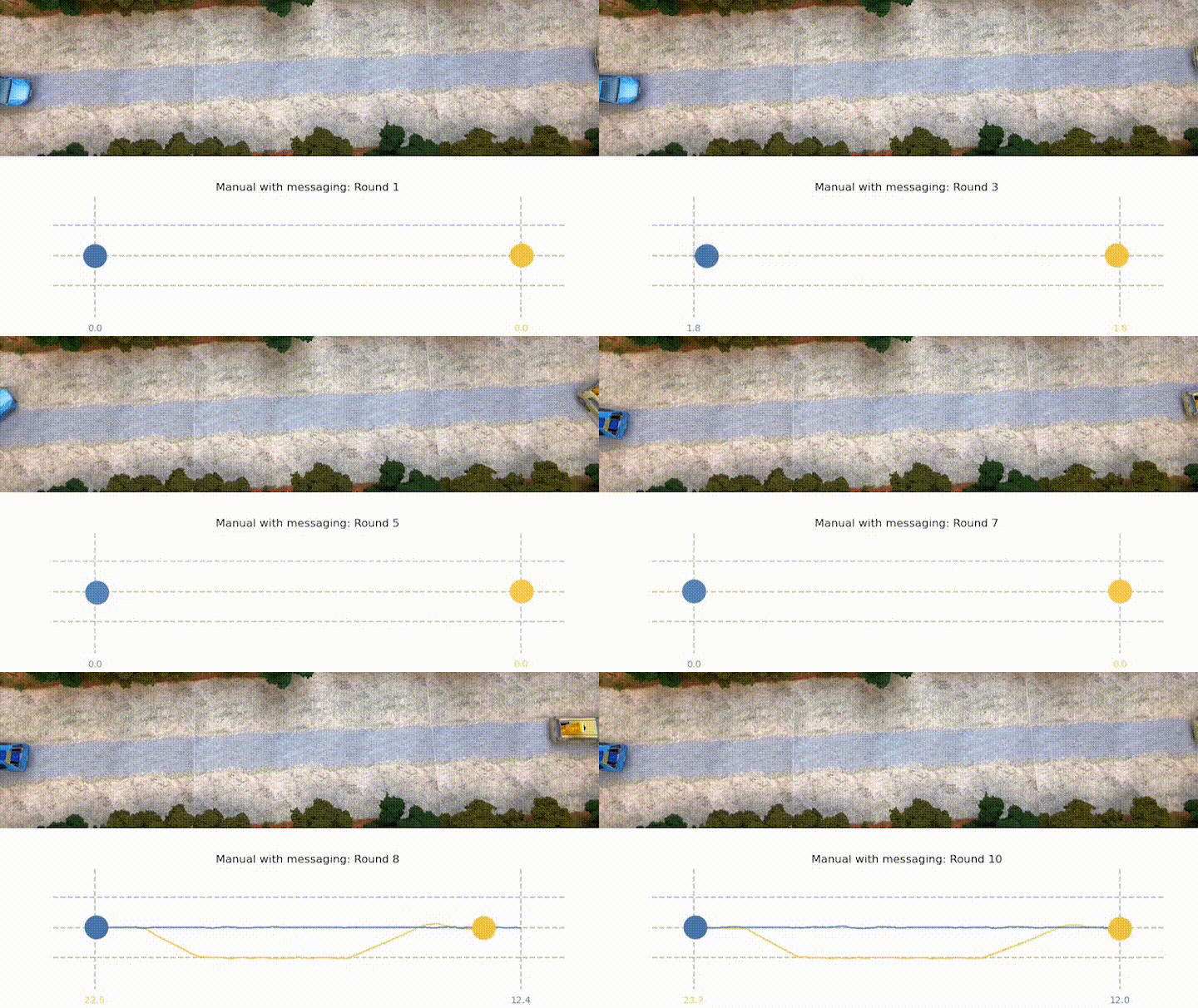
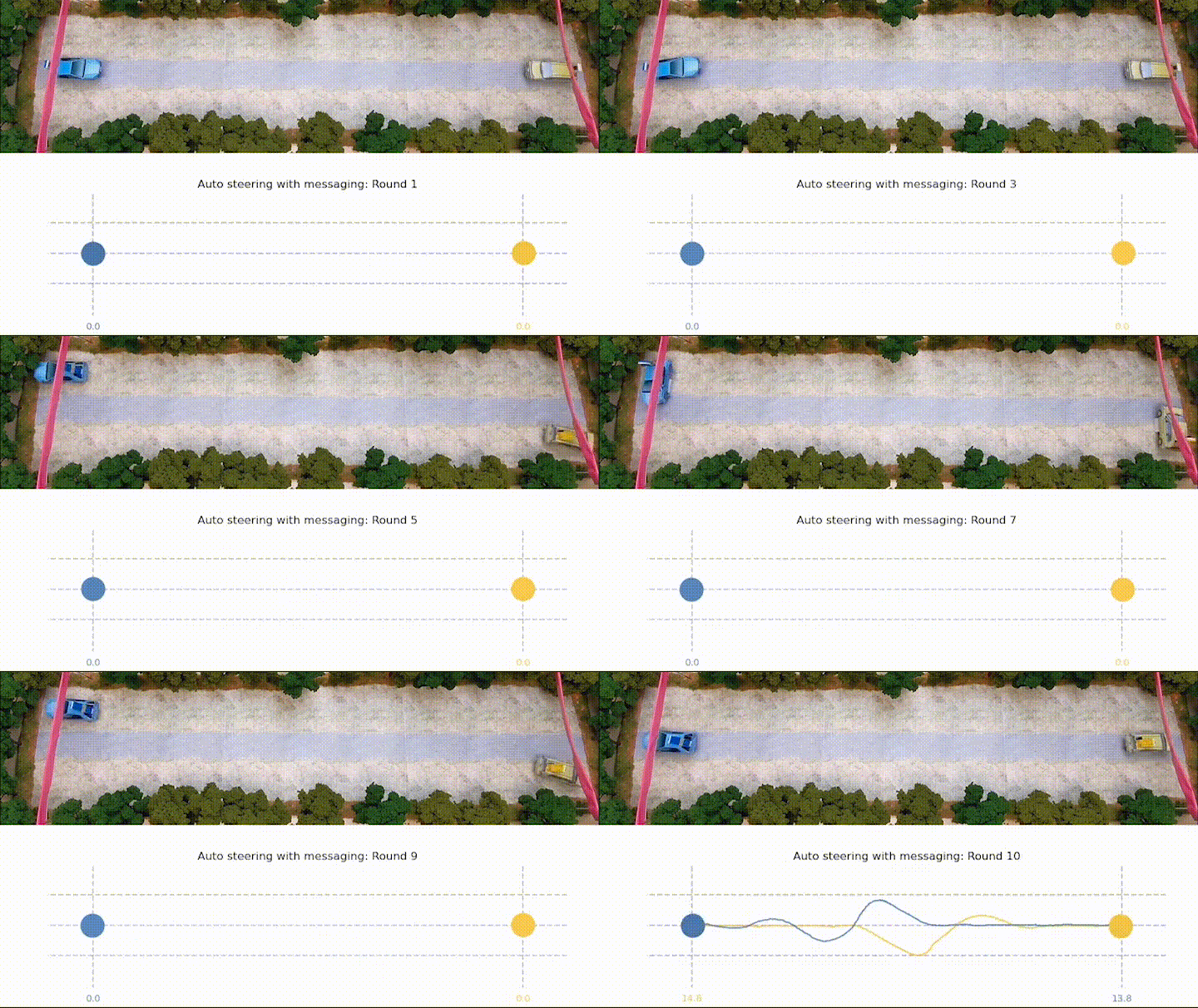
Autosteering changed the structure of the game. Because the car avoids a head-on collision by itself, going straight pays at least as well as swerving whatever the partner does, which turns the chicken game into a prisoner’s dilemma. The drivers behaved accordingly. With autosteering, they did not swerve before the warning on 97.0% of occasions without messaging and 96.0% with it, drove faster, and left the swerve to the machine 88.3% and 71.0% of the time. When both relied on the machine, the two cars swerved at the same moment and nobody gave way. Measured as social value orientation, purely self-interested driving rose from 13.6% of the time with manual driving to 79.3% with autosteering.
Communication fell as well. Drivers sent at least one message 42.3% of the time with manual driving, 27.7% with autobraking and 15.3% with autosteering, and with autosteering a message was both sent and received only 5.3% of the time, often because the cars had already passed each other. Since exchanging messages helped pairs take the step from one concession to taking turns, the drop in communication also stood in the way of reciprocity.
Payoffs alone do not explain the collapse. With both systems, the automatic swerve cost more than a manual one, so taking turns paid best, and drivers again often gave way; still, they took turns in only 5.3% of rounds and used messaging only 17.7% of the time. The paper suggests two mechanisms that can act together: the assistance changes the structure of the interaction and its economic equilibrium, and it dissolves people’s sense that they face a joint problem.
Egocentric driving outlasted the assistance
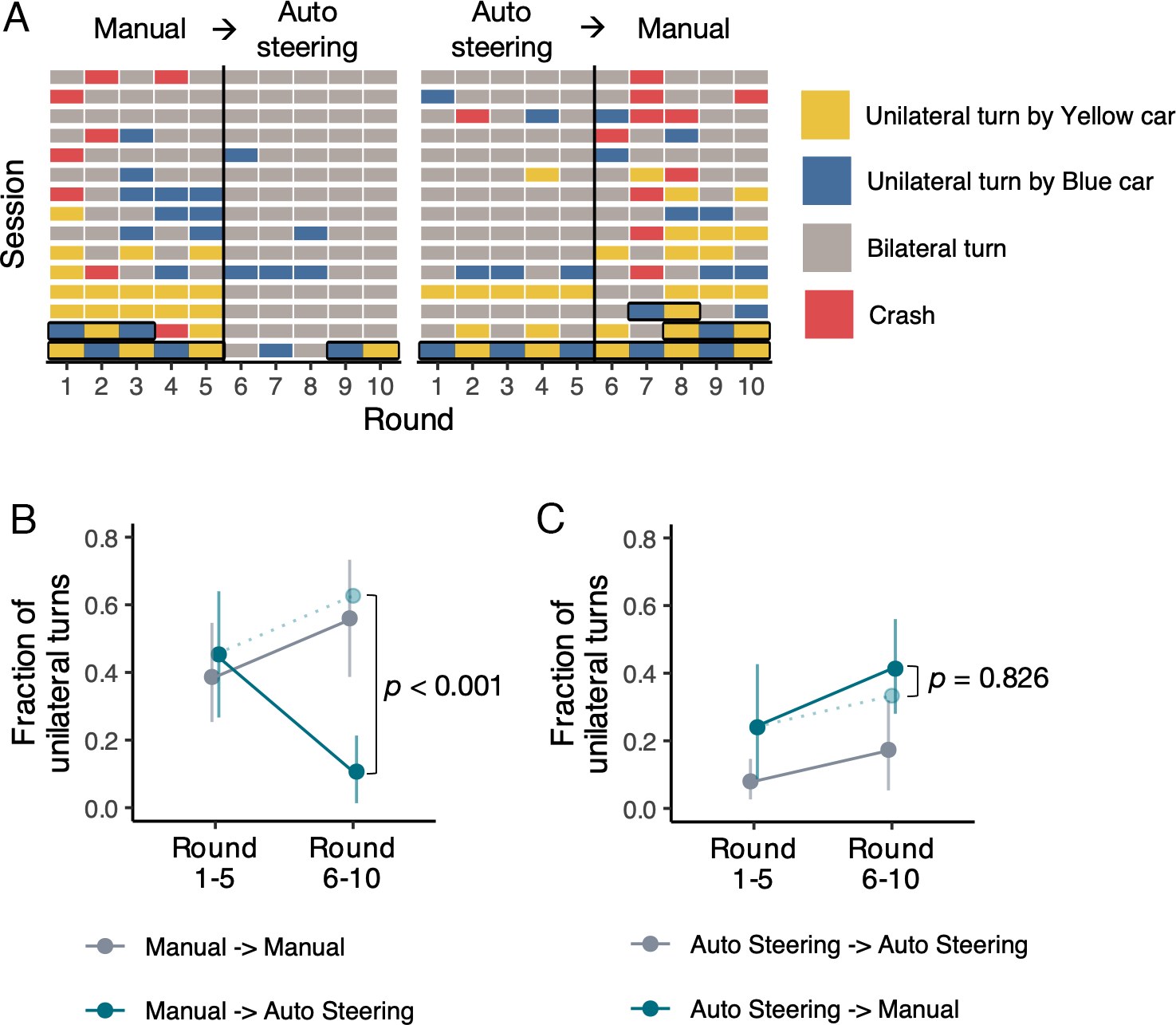
When autosteering was switched on halfway through the game, drivers quickly gave way less often. When it was switched off, they did not go back: they gave way no more often than pairs who kept autosteering, and their driving and communication did not change. Once introduced, assistance can alter the economic and normative bases of coordination between people, and recovering them may take effort and time.
Efficient for each driver, without reciprocity
Autosteering paid off for individuals. Drivers with autosteering reached the goal 2.5 s faster and earned more than in any other condition, US$0.654 per round against US$0.558 with manual driving (both with messaging). Seen the other way, manual drivers paid a 14.7% “surcharge” for the opportunity to take turns. Higher earnings raised drivers’ satisfaction with their own driving but not with their counterparts, which depended instead on whether the counterpart had given way to them.
The paper concludes that people treat each other as social actors by default, especially when they can communicate, but as impersonal obstacles when active safety assistance takes over; the pairs with autosteering moved like physical particles repelling each other. Humans have developed norms of reciprocity to address collective problems, and such tacit agreements can break down when machines without any normative commitments take over human decisions. As humans and machines come to share roads and other spaces, such systems need to consider people’s social and normative motives, not only individual safety and efficiency.
Reference
Hirokazu Shirado, Shunichi Kasahara, and Nicholas A. Christakis. 2023. Emergence and collapse of reciprocity in semiautomatic driving coordination experiments with humans. Proceedings of the National Academy of Sciences 120, 51, Article e2307804120 (December 2023). https://doi.org/10.1073/pnas.2307804120
BibTeX
@article{10.1073/pnas.2307804120,
  author    = {Shirado, Hirokazu and Kasahara, Shunichi and Christakis, Nicholas A.},
  title     = {Emergence and collapse of reciprocity in semiautomatic driving coordination experiments with humans},
  journal   = {Proceedings of the National Academy of Sciences},
  volume    = {120},
  number    = {51},
  year      = {2023},
  articleno = {e2307804120},
  publisher = {National Academy of Sciences},
  doi       = {10.1073/pnas.2307804120}
}
Figures from the paper (Shirado et al., PNAS 2023), licensed under CC BY-NC-ND 4.0.
- News: The new paper is out from PNAS.
- Related projects: Realism Drives Interpersonal Reciprocity