Realism Drives Interpersonal Reciprocity but Yields to AI-Assisted Egocentrism in a Coordination Experiment
Hirokazu Shirado, Kye Shimizu, Nicholas A. Christakis, and Shunichi Kasahara
ACM CHI 2025
The collaboration project with the leading author Hirokazu Shirado (Carnegie Mellon University), Kye Shimizu [MIT Media Lab], and Nicholas A. Christakis (Yale University)
Paper (ACM Digital Library) · PDF
Abstract
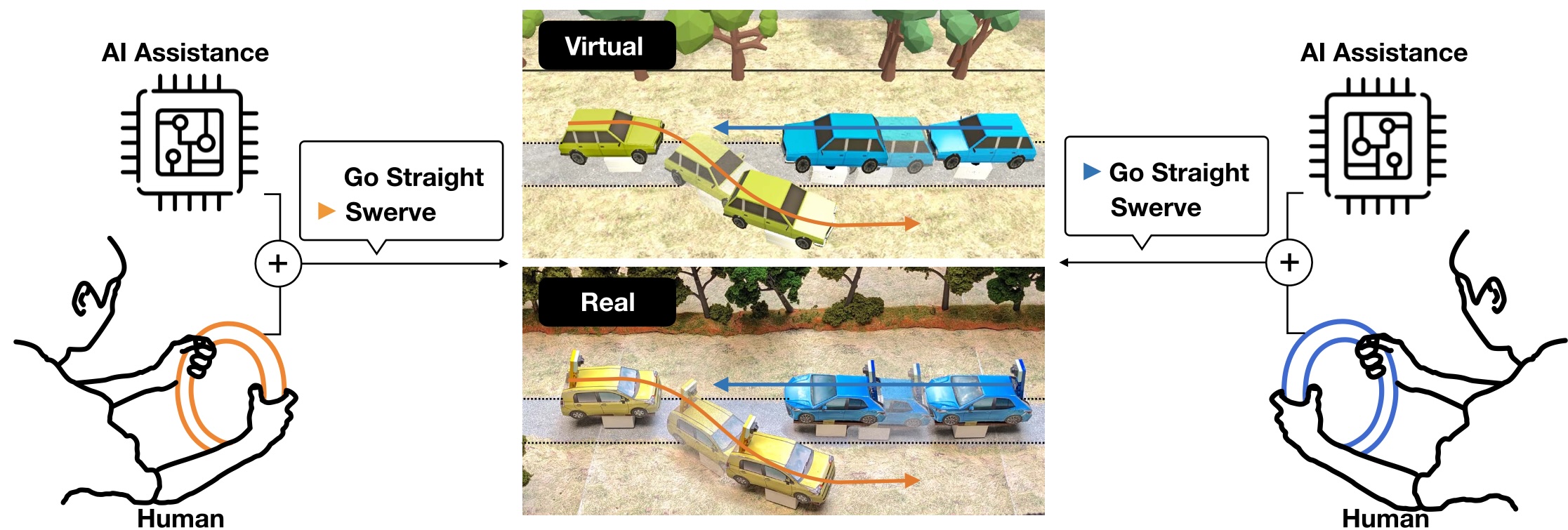
Virtual reality technologies that enhance realism and artificial intelligence (AI) systems that assist human behavior are increasingly interwoven in social applications. However, how these technologies might jointly influence interpersonal coordination remains unclear. We conducted an experiment with 240 participants in 120 pairs who interacted through remote-controlled robot cars in a physical space or virtual cars in a digital space, with or without autosteering assistance, using the chicken game, an established model of interpersonal coordination. We find that both realism and AI assistance help improve user performance but through opposing mechanisms. Real-world contexts enhanced communication, fostering reciprocal actions and collective benefits. In contrast, autosteering assistance diminished the need for interpersonal coordination, shifting participants’ focus towards self-interest. Notably, when combined, the egocentric effects of autosteering assistance outweighed the prosocial effects of realism. The design of HCI systems that involve social coordination will, we believe, need to take such effects into account.
When realism meets AI assistance
Two technologies increasingly shape how people coordinate with one another. Virtual and augmented reality make digital spaces feel more real, and AI assistance, such as driving assistance or recommendations, takes over parts of people’s decisions. Their effects on social behavior have been studied separately, with the assumption that each helps and that the two together would help even more. We asked how realism and AI assistance jointly shape coordination between people.
We used the chicken game, a standard model of coordination. Two drivers head toward each other on a single road, and each wants to reach the goal quickly. Swerving off the road costs time, and if neither swerves, they crash. Over repeated rounds, a pair can take turns giving way, which gives both of them the best payoff, but someone has to concede first without knowing whether the other will return the favor.
Remote driving with real and virtual cars
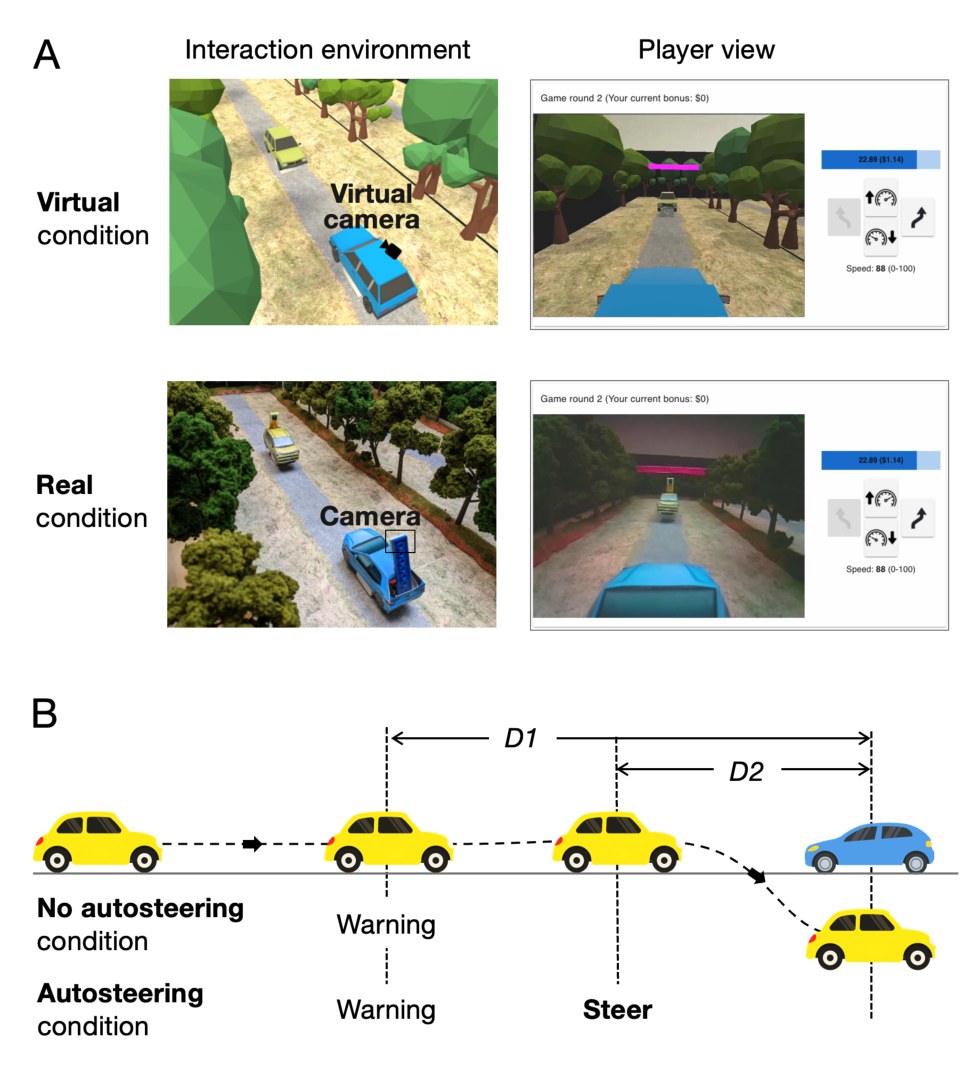
240 participants in 120 pairs drove remotely from their browsers, ten rounds with the same partner, earning a bonus that shrank the longer they took to reach the goal. In the real condition, they drove palm-sized robot cars in a physical diorama; in the virtual condition, virtual cars in a 3D scene. Both used the same first-person camera view and controls, and every participant knew which kind of car they were driving. Half of the pairs had autosteering, which steered the car away from an obstacle at close range, and half could send two fixed messages, “Go ahead.” and “Thank you!”. Each of the eight combinations had 15 pairs, as preregistered.
What realism changed
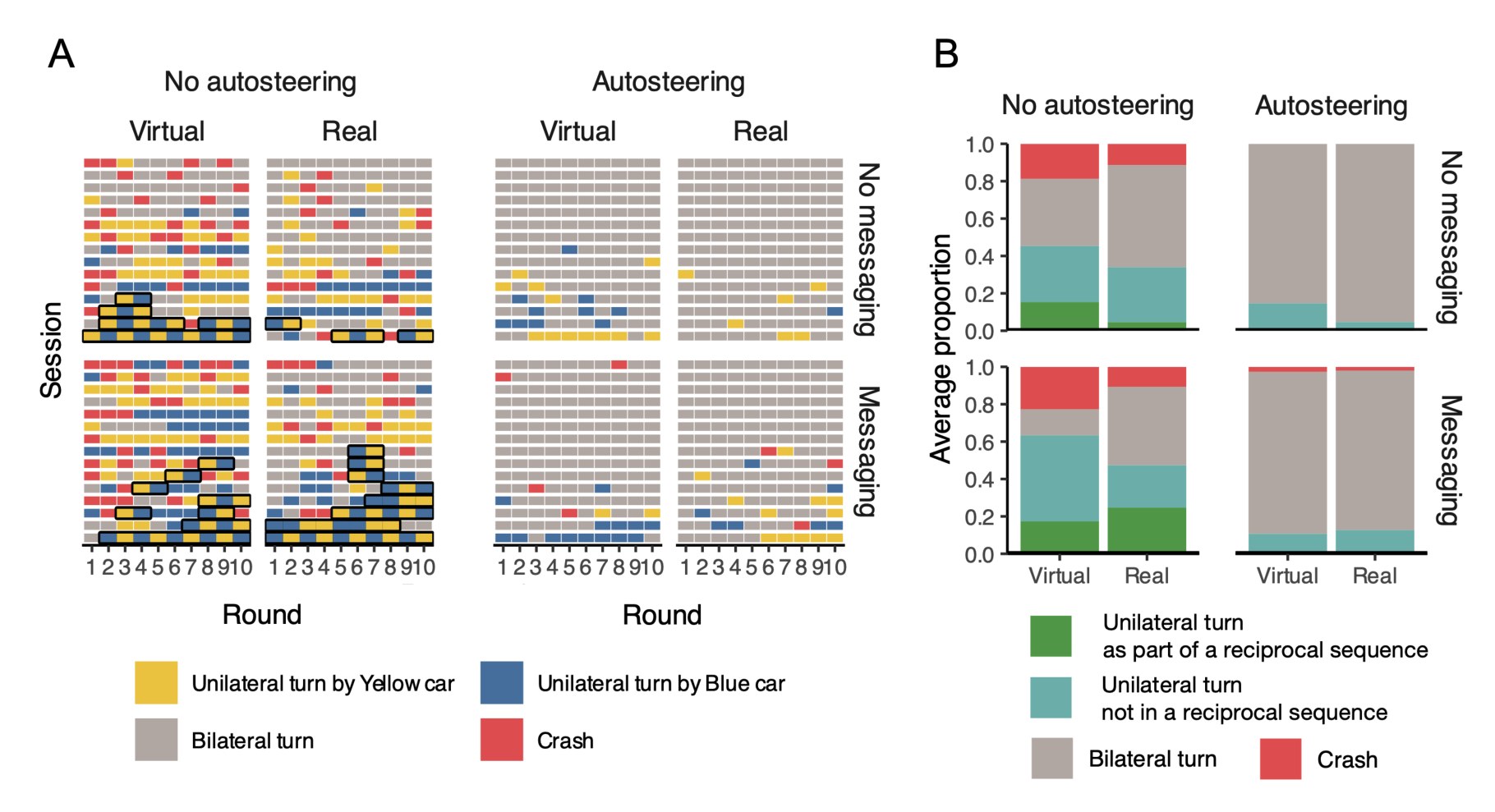
Without autosteering, realism did make a difference. With real cars, pairs crashed less often than with virtual cars (11.3% against 18.7% of rounds without messaging, 10.7% against 22.7% with it). Realism also strengthened the effect of communication: with messaging, pairs with real cars took turns giving way in 24.7% of rounds against 17.3% with virtual cars, as drivers of real cars were more inclined to signal their concessions. Without messaging the order was reversed (4.7% against 15.3%), because drivers of real cars delayed their decision to swerve, leaving their partner less time to notice a concession.
AI assistance outweighed realism
Realism shaped how people coordinated, but the effect of autosteering was far stronger: with autosteering, no pair took turns giving way in any condition, whether the cars were real or virtual and whether or not the drivers could send messages. In the statistical model, autosteering had an even stronger effect than realism on both collisions and turn-taking, and it suppressed turn-taking regardless of the setting and of messaging. The analysis found no interaction between realism and AI assistance, and the paper argues that this absence is itself the finding: the influence of AI assistance is so dominant that it overrides the effects of realism. Realism alone is not enough to sustain coordination between people once AI assistance takes over critical decisions.
Why autosteering made drivers egocentric
Autosteering changed the structure of the game. In the chicken game, each driver’s best move depends on what the other does, which is why drivers watch, anticipate and signal. When the car avoids collisions by itself, going straight pays off whatever the partner does, and the reason to coordinate is gone.
The drivers behaved accordingly. Without autosteering, they gave way before the warning 37.9% of the time; with autosteering, 6.6% of the time. They also communicated less. Measured as social value orientation, which places each action between self-interest and concern for the other driver, purely self-interested actions rose from 19.4% without autosteering to 66.6% with it. One participant described the strategy: “I knew that the automatic steering would save me, so I just tried to accelerate to the limit and turn back onto the road as quickly as I could.”
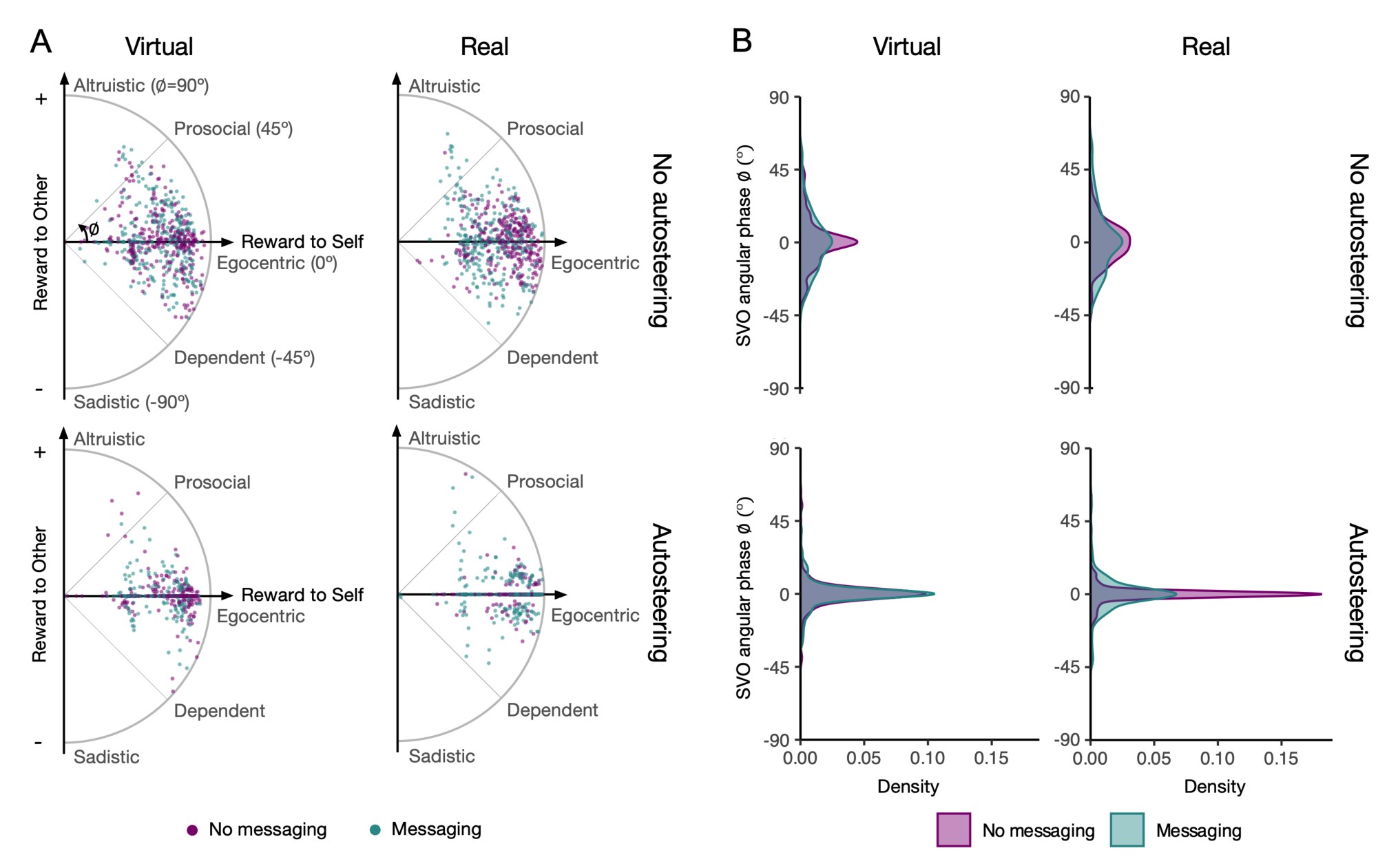
Realism works through people’s perception of the situation, but the AI assistance does not perceive whether the situation is real. Once people hand decisions to it, realism has less to act on.
Two routes to better performance
Both realism and autosteering raised what participants earned, through opposite mechanisms. With real cars, drivers communicated and took turns, sharing the road more efficiently. With autosteering, drivers paid little attention to each other and drove as fast as they could, relying on the system to avoid collisions; this served individual gain and still reduced crashes. Participants with autosteering were also more satisfied with their own driving.
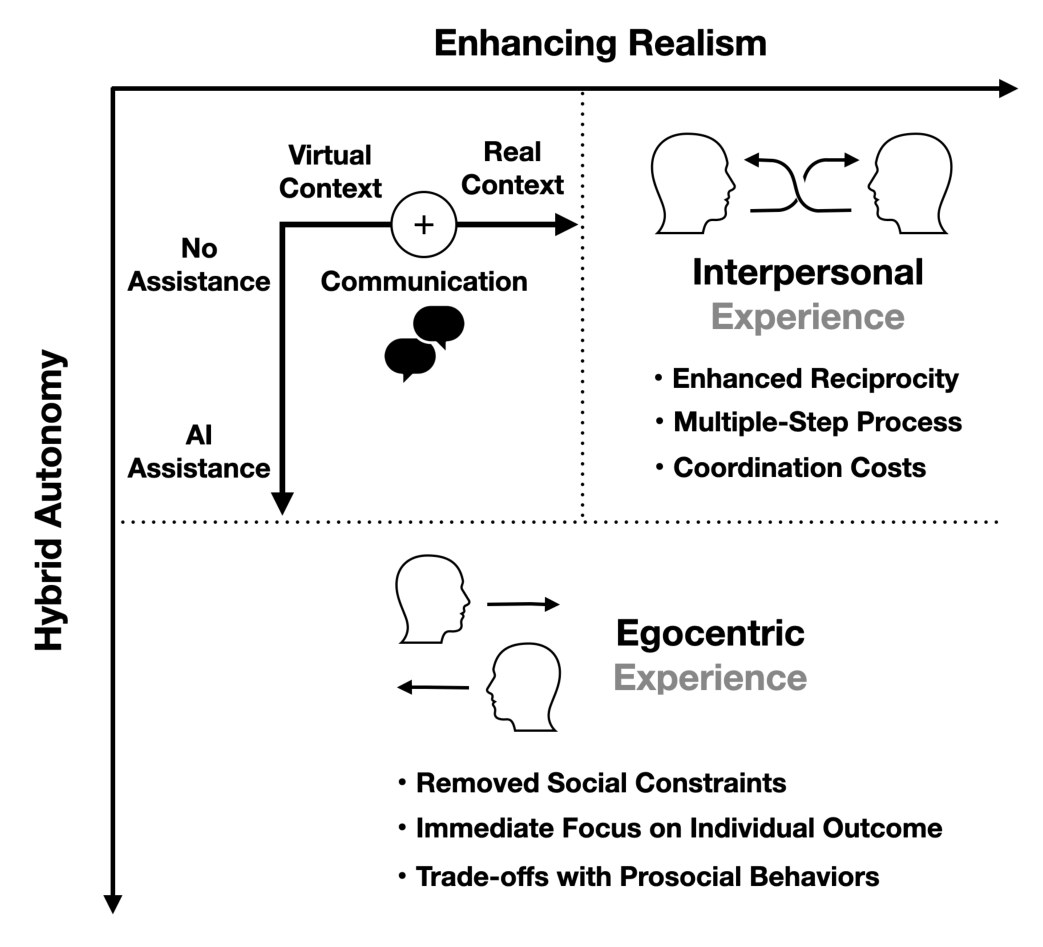
The paper turns this into guidance for design. Systems meant to support interpersonal experience can draw on realism, but they need ways to communicate, even small preformatted cues like the messages in this study. Strong AI assistance suits tasks where individual efficiency and safety come first, such as operating machinery. Where AI assistance is added to social settings, its egocentric effect can override the prosocial behavior that realism supports, a concern for any system in which a person and an AI act as one, from driving to real-time conversation and tele-robotics.
Reference
Hirokazu Shirado, Kye Shimizu, Nicholas A. Christakis, and Shunichi Kasahara. 2025. Realism Drives Interpersonal Reciprocity but Yields to AI-Assisted Egocentrism in a Coordination Experiment. In Proceedings of the 2025 CHI Conference on Human Factors in Computing Systems (CHI ’25). Association for Computing Machinery, New York, NY, USA, Article 693, 1–21. https://doi.org/10.1145/3706598.3713371
BibTeX
@inproceedings{10.1145/3706598.3713371,
  author    = {Shirado, Hirokazu and Shimizu, Kye and Christakis, Nicholas A. and Kasahara, Shunichi},
  title     = {Realism Drives Interpersonal Reciprocity but Yields to AI-Assisted Egocentrism in a Coordination Experiment},
  booktitle = {Proceedings of the 2025 CHI Conference on Human Factors in Computing Systems},
  series    = {CHI '25},
  year      = {2025},
  articleno = {693},
  pages     = {1--21},
  publisher = {Association for Computing Machinery},
  address   = {New York, NY, USA},
  doi       = {10.1145/3706598.3713371}
}
Figures from the paper (Shirado et al., CHI ’25), licensed under CC BY-NC 4.0.