Conversational Agents on Your Behalf: Opportunities and Challenges of Shared Autonomy in Voice Communication for Multitasking The collaboration project with the leading author, a Sony CSL Summer Intern, Yi Fei Cheng (Carnegie Mellon University), and Hirokazu Shirado (Carnegie Mellon University) Abstract Advancements in computational agents will enable them to act as surrogates for users in…
The study explores how realism and AI assistance impact interpersonal coordination. While realism promotes collaboration, AI tends to encourage self-interest, overshadowing the benefits of social interaction.
AgiLimb: Embodied Agile Robotic Arm by Integrating Digital Reflex and Seamless Action Takeover The collaboration project with the leading lab of Ryuma Niiyama, Yusuke Kawashima and Yoshiaki Abe (Meiji Univ.) and Takeru Hashimoto (Sony CSL). Abstract Performing sports skills with a human-operated robot is a challenging task. The key to human-robot-human (HRH) interaction is to…
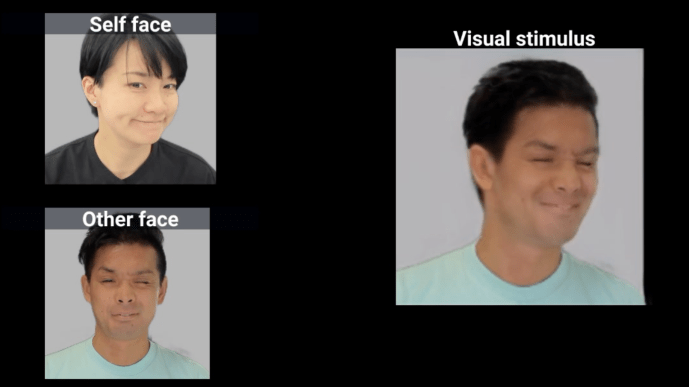
Control over self and others’ face: Exploitation and exploration The collaboration project with Wen Wen, Hakan Aktaş, Jie Mei, Acer Chang, Yosuke Suzuishi. Abstract The face serves as a crucial cue for self-identification, while the sense of agency plays a significant role in determining our influence through actions in the environment. The current study investigates how self-identification through facial…
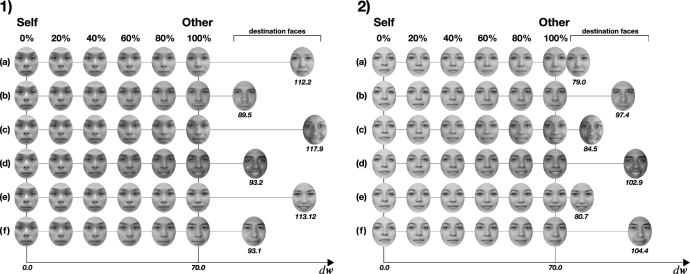
Investigating the impact of motion visual synchrony on self-face recognition using real-time morphing Abstract Face recognition is a crucial aspect of self-image and social interactions. Previous studies have focused on static images to explore the boundary of self-face recognition. Our research, however, investigates the dynamics of face recognition in contexts involving motor-visual synchrony. We first…
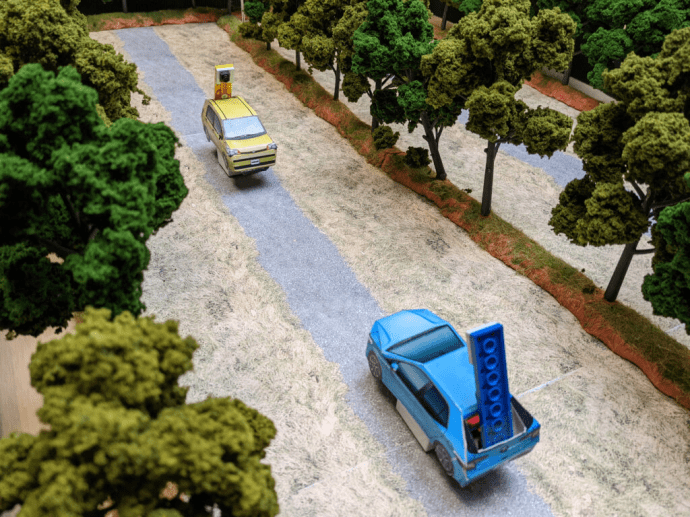
Emergence and collapse of reciprocity in semiautomatic driving coordination experiments with humans The collaboration project with the lead author Hirokazu Shirado (CMU) and Christakis, N (Yale University). Abstract Forms of both simple and complex machine intelligence are increasingly acting within human groups in order to affect collective outcomes. Considering the nature of collective action problems,…
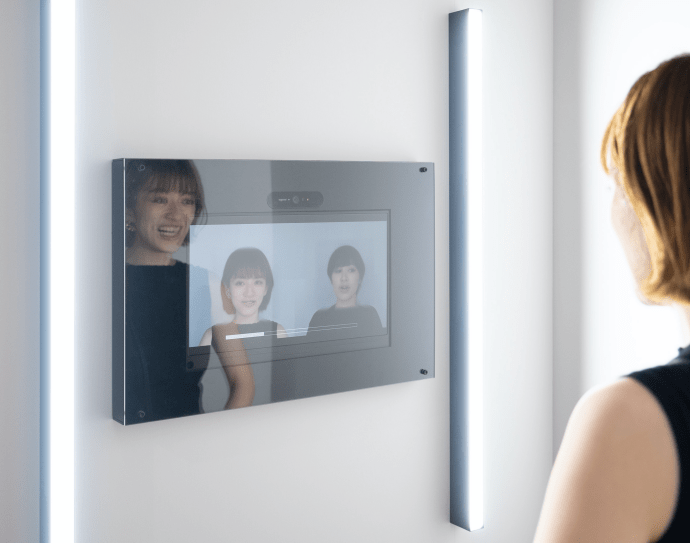
Morphing Identity: Exploring Self-Other Identity Continuum through Interpersonal Facial Morphing Experience We explored continuous changes in self-other identity by designing an interpersonal facial morphing experience where the facial images of two users are blended and then swapped over time. Both users’ facial images are displayed side by side, with each user controlling their own morphing…
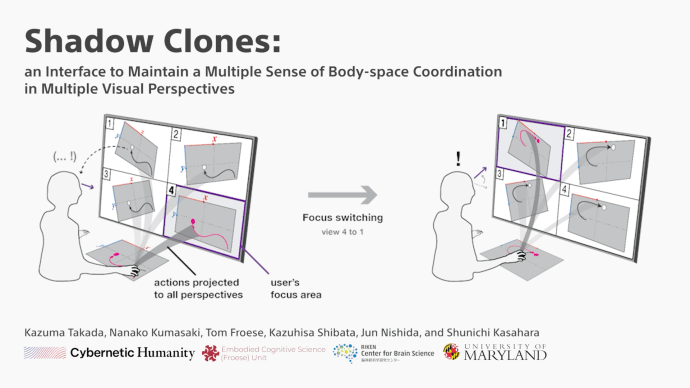
ShadowClones: an Interface to Maintain a Multiple Sense of Body-space Coordination in Multiple Visual Perspectives We propose ShadowClones, an interface that supports interactions in which a single user can interact with multiple bodies in multiple spaces. Recent teleoperation technologies have allowed a user controlling multiple objects simultaneously, but at the same time, it also exhibited…
How can the computer facilitate interpersonal joint action, which is the collaborative action conducted by multiple persons? To explore this research question, we develop EMAS (ElectroMagnetic Actuation System): a motion transfer system using electromagnets, allowing the users to share their finger motion. EMAS consisting of wearable magnets and electromagnets can drive finger motions such as…
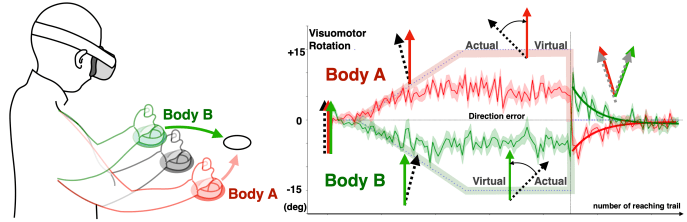
Parallel Adaptation: Switching between Two Virtual Bodies with Different Perspectives Enables Dual Motor AdaptationAdrien Verhulst, Yasuko Namikawa, Shunichi Kasahara (Sony CSL), The 21st IEEE ISMAR 2022 Full Paper. Abstract Virtual Reality (VR) lets us experiment embodiment. Here we investigate dual embodiment under the prism of dual motor adaptation. We asked participants (N=21) to perform reaching…



 Cybernetic Humanity